

 English
 русский
 Français
 Español
 عربى

Cleanroom HPL Door: Hygienic Performance, Durable Construction, and Reliable Manufacturing
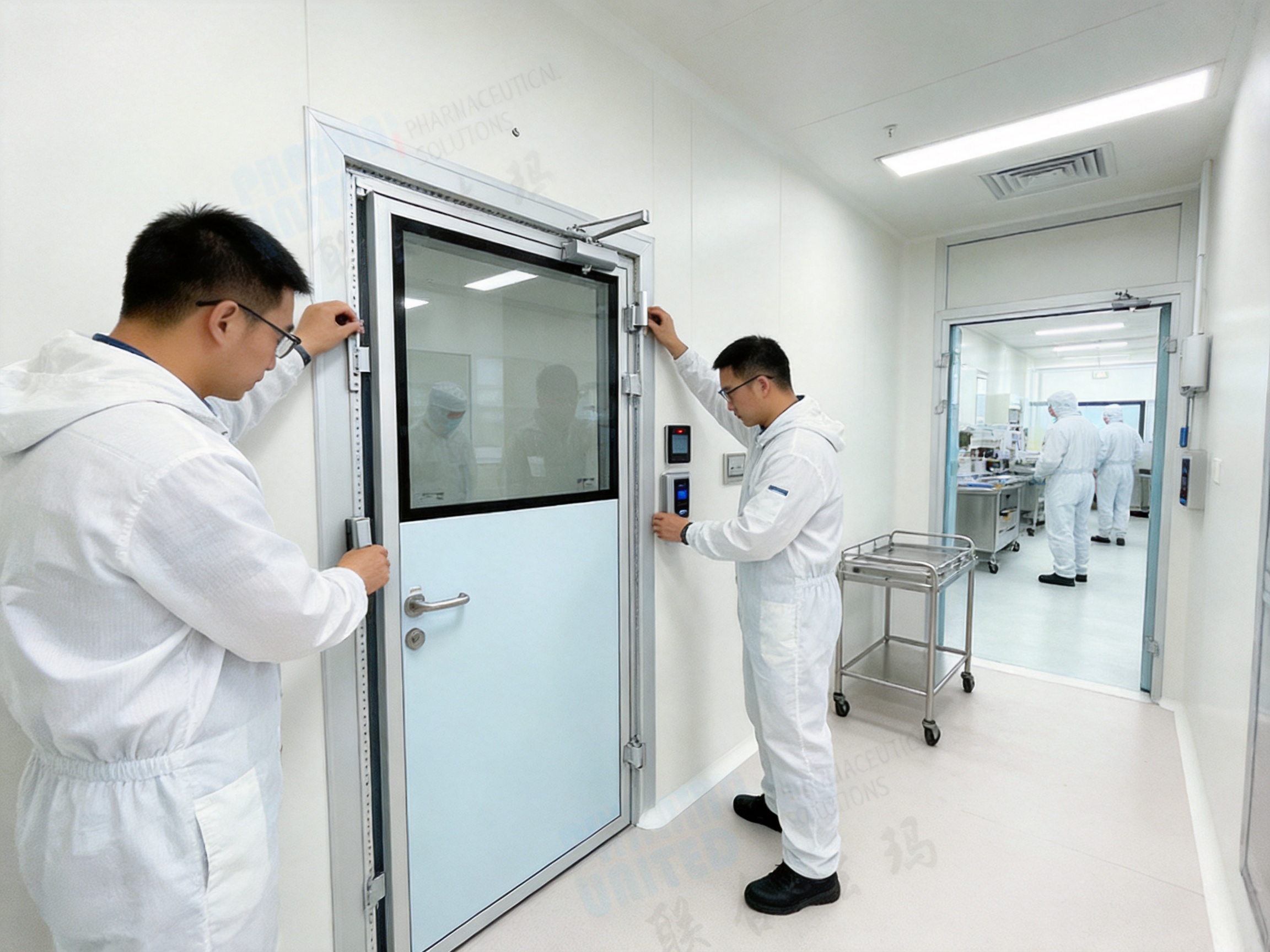
Cleanroom doors are essential components in controlled environments. They separate rooms with different cleanliness classifications, help maintain pressure cascades, reduce contamination risks, and support efficient personnel and material movement. A poorly selected door can undermine an otherwise well-designed cleanroom by creating difficult-to-clean surfaces, air leakage, premature wear, or maintenance problems. For this reason, pharmaceutical manufacturers, hospitals, laboratories, food processors, and advanced industrial facilities require doors that combine hygiene, strength, dimensional stability, and dependable operation.
The Cleanroom HPL Door is designed for these demanding applications. Its high-pressure laminate surface provides a smooth, durable, and hygienic finish, while its engineered door structure delivers the strength required for areas with frequent traffic. The door can be manufactured according to project dimensions and coordinated with cleanroom wall panels, frames, hardware, access-control systems, and air-conditioning requirements.
Unlike ordinary commercial doors, a cleanroom door must be evaluated as part of a complete environmental-control system. Surface materials, edge details, frame construction, sealing, hardware, cleaning compatibility, and installation quality all influence the final performance. The Cleanroom HPL Door is developed with this integrated perspective, making it suitable for projects that demand reliable operation and long service life rather than only an attractive appearance.
Pharma United Co., Ltd. supports the product with cleanroom engineering experience, in-house manufacturing, customization capabilities, and project installation services. The company provides cleanroom panels, doors and windows, HVAC-related systems, equipment, and turnkey engineering support for pharmaceutical, healthcare, food, laboratory, and industrial applications.
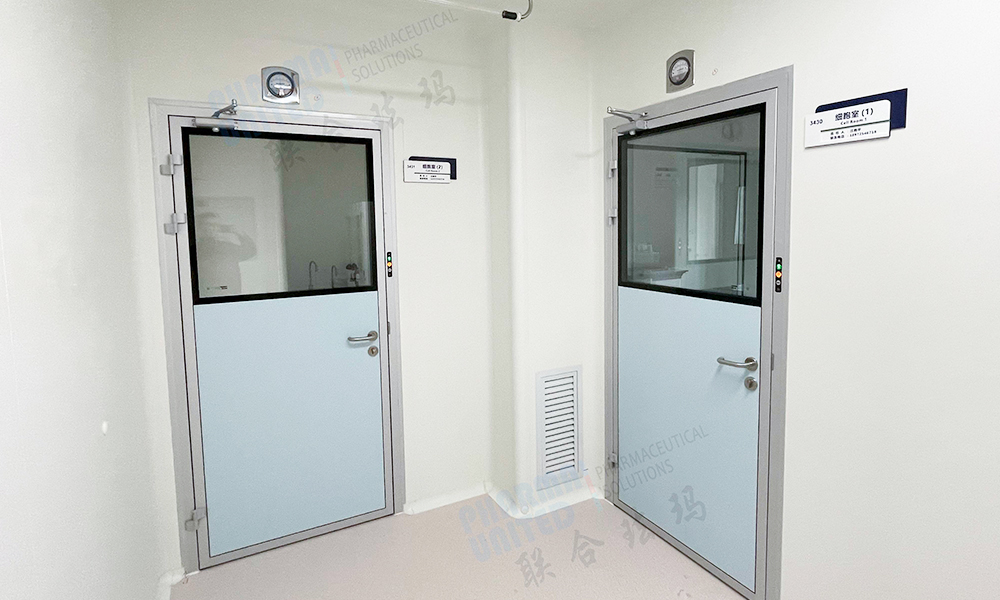
Cleanroom HPL Door
What Is a Cleanroom HPL Door?
A Cleanroom HPL Door is a specially constructed door with a high-pressure laminate surface intended for use in controlled or hygienic environments. HPL, or high-pressure laminate, is manufactured by pressing decorative and kraft paper layers under high pressure and temperature. The resulting sheet has a compact, resilient surface that can withstand regular cleaning, impact, abrasion, and general operational wear.
In a cleanroom application, the HPL surface is combined with a rigid door assembly and a suitable frame. The supplied configuration is customized according to opening dimensions, traffic conditions, wall construction, room classification, hardware requirements, and the project’s preferred finish. The standard product information identifies a steel frame, a steel door panel, and paper honeycomb infill. The current listed configuration does not include a glazing window, although glazing can be evaluated as a project-specific option when visibility or supervision is required.
The product is suitable for single-leaf or other engineered configurations, depending on the project design. Door size, frame details, hinges, locks, seals, vision panels, kick plates, handles, closers, and access-control components can be coordinated during the technical design stage.
Why HPL Is Suitable for Controlled Environments
Cleanroom surfaces must be easy to clean and resistant to damage. HPL provides a practical balance between surface durability, appearance, and maintenance. Its compact finish has fewer irregularities than many conventional painted or porous surfaces. When properly fabricated and sealed, it helps prevent the accumulation of dust and supports routine wiping and disinfection procedures.
The surface is also resistant to common forms of mechanical stress. Doors in pharmaceutical plants, laboratories, hospitals, and food workshops may be opened hundreds or thousands of times each day. Personnel may push the door with carts, containers, tools, or gloved hands. Equipment may pass through the opening repeatedly. A surface that scratches or chips easily can become difficult to clean and may require early replacement. HPL is designed to tolerate this type of demanding use more effectively than many ordinary decorative finishes.
Another important benefit is appearance retention. A clean, uniform door surface contributes to the professional appearance of a controlled facility and makes visible damage easier to identify. Consistent surfaces also simplify the visual inspection of production areas. Different colors or identification schemes may be considered where the project requires room coding, personnel-flow separation, or departmental identification.
Core Product Advantages
1. High Impact Resistance
Frequent traffic is one of the main causes of damage to doors in industrial and healthcare facilities. Carts, pallet trucks, material bins, and maintenance tools can strike door leaves and frames. The HPL-facing construction is designed to withstand routine impacts better than fragile or easily dented finishes.
The steel-based construction further supports mechanical strength. The door panel and frame can be engineered to remain stable under normal operating loads, while the selected infill helps create a lightweight but sufficiently rigid assembly. This combination is valuable where personnel need to operate the door smoothly without sacrificing durability.
2. Scratch and Abrasion Resistance
Scratches are not merely a visual problem. Deep scratches can create places where dirt and cleaning residues accumulate, especially when the damaged area is difficult to reach. A scratch-resistant HPL surface helps preserve a continuous, smooth finish during daily operation.
Compared with low-grade painted surfaces, the HPL finish can provide improved resistance to scuffing and routine abrasion. This is particularly useful in corridors, gowning rooms, material transfer areas, laboratories, and production spaces where repeated movement occurs close to the door surface.
3. Corrosion Resistance
Controlled environments may involve frequent cleaning, disinfectants, humidity, temperature changes, and chemical exposure. The external finish and protective treatment of the door must therefore be selected with the operating environment in mind. HPL offers a protective surface that can help resist common forms of surface deterioration when the correct cleaning agents and maintenance procedures are followed.
The frame, hardware, edge treatment, and fasteners should be specified according to the project’s chemical and humidity conditions. For especially aggressive environments, stainless steel or other corrosion-resistant components may be considered. Pharma United’s engineering team can coordinate these details with the cleanroom process requirements.
4. Easy Cleaning
Cleanability is one of the most important differences between a cleanroom door and a conventional interior door. The door should have smooth surfaces, limited exposed ledges, properly sealed joints, and hardware that does not create unnecessary contamination traps. The HPL surface supports wipe-down cleaning and routine sanitation.
Cleaning compatibility must always be confirmed with the selected disinfectant manufacturer and the project’s standard operating procedures. Excessively abrasive pads, unapproved solvents, or prolonged chemical exposure may damage even a durable surface. With appropriate maintenance, the door can support the hygiene requirements of pharmaceutical, laboratory, medical, food, and other controlled areas.
5. Long-Term Appearance and Functional Stability
A cleanroom door is expected to maintain reliable performance for many years. Door leaves that warp, frames that move, or hardware that becomes loose can produce air leakage and operational difficulties. The steel frame and steel panel configuration provides a stable foundation for accurate fabrication and installation.
Dimensional stability is particularly important when the door is installed in a sandwich-panel partition. The door frame must align with the wall system, and the surrounding structure must be capable of supporting the selected hardware. Factory-controlled production and project-specific drawings help reduce fitting problems during installation.
6. Custom Manufacturing
Cleanroom projects rarely use one universal door size. Door openings vary according to personnel flow, equipment dimensions, material-handling methods, wall thickness, and site limitations. The Cleanroom HPL Door is offered in customized dimensions, allowing it to be coordinated with the architectural and engineering drawings.
Customization can include door width and height, frame depth, swing direction, hardware position, vision-panel requirements, surface color, seals, kick plates, closers, access control, and compatibility with interlocking systems. A technical review is recommended before production so that every component matches the cleanroom layout.
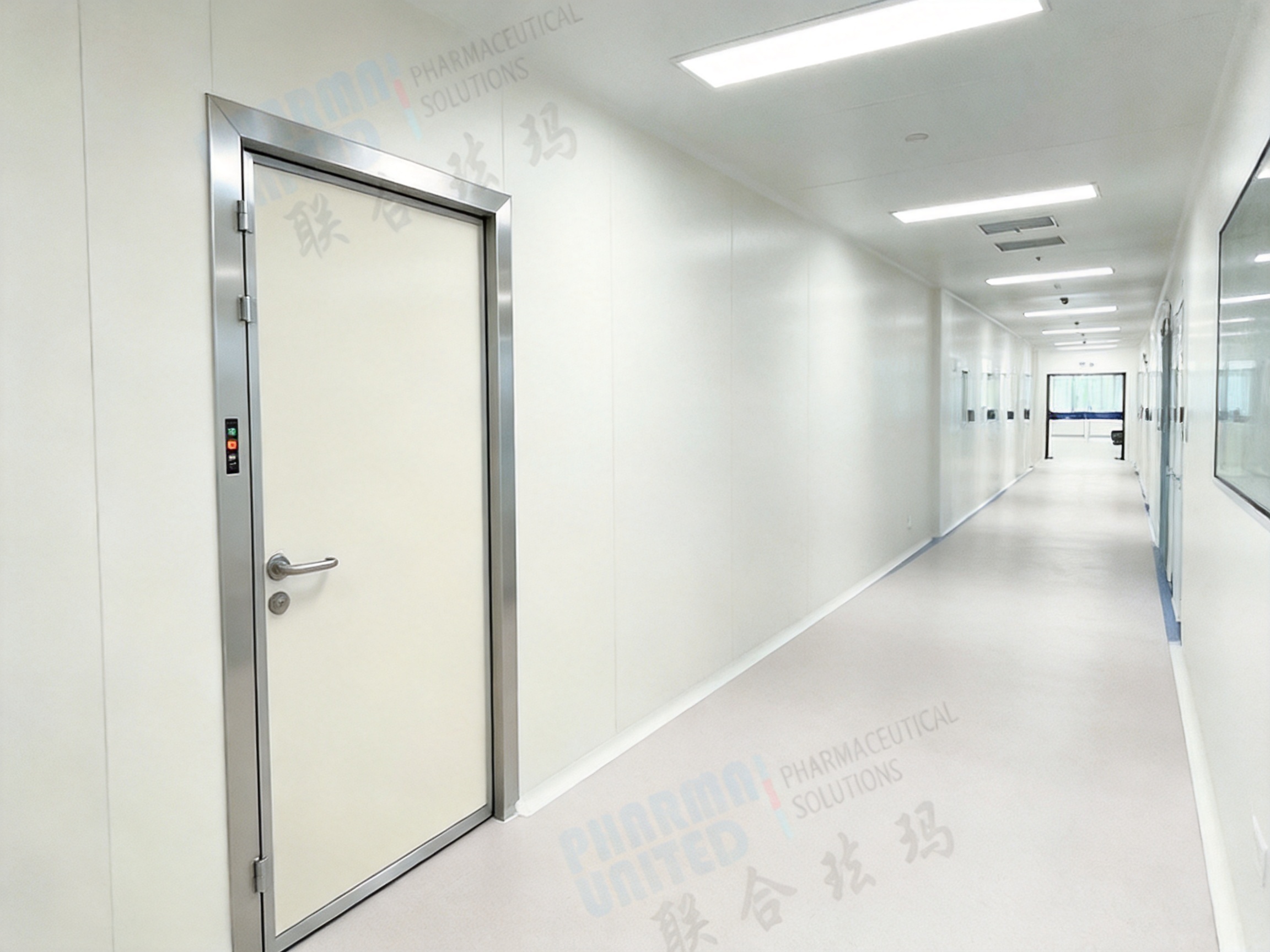
Construction and Technical Configuration
The product’s listed technical information includes a customized size, steel door frame, steel door panel, paper honeycomb infill, and no standard glazing window. This configuration is appropriate for projects requiring a robust and relatively lightweight cleanroom door. The paper honeycomb core can support rigidity while avoiding the unnecessary weight associated with some solid-core constructions.
| Parameter | Standard Listed Value | Project Consideration |
|---|---|---|
| Product type | Cleanroom HPL Door | Suitable for pharmaceutical, laboratory, healthcare, food, and industrial cleanrooms |
| Size | Customized | To be confirmed according to opening, traffic, equipment, and wall layout |
| Door frame | Steel | Frame depth, finish, sealing, and connection details should match the partition system |
| Door panel | Steel with HPL surface application | Panel thickness and edge construction are selected according to project requirements |
| Infill | Paper honeycomb | Provides a practical balance between rigidity and door weight |
| Glazing window | Not included in the listed configuration | Optional vision-panel design can be reviewed when required |
| Color | To be confirmed | Color selection may support room identification and project aesthetics |
| Interlock | Not included in the listed configuration | Electronic or mechanical interlocking can be coordinated as an option |
The table describes the available reference configuration rather than limiting the engineering possibilities of the product. Cleanroom doors should be selected according to actual process requirements. For example, a pharmaceutical weighing room may need a different hardware package from a hospital corridor, while a food-processing transfer room may require enhanced moisture and corrosion protection.
Steel Frame
The steel frame provides structural support around the door opening. A properly fabricated frame helps maintain door alignment, supports hinges and closers, and creates a controlled interface with the cleanroom wall. The frame may be prepared for different wall thicknesses and installation methods, including coordination with modular cleanroom panels.
Frame design should include attention to corners, welds, fastener locations, sealant joints, and exposed surfaces. Smooth transitions are preferred because they reduce dust accumulation and simplify cleaning. Where the facility requires a higher level of corrosion protection, the frame finish and material should be selected in accordance with the room environment.
Steel Door Panel
The steel door panel gives the assembly a stable structural body. The HPL surface adds a durable, cleanable exterior finish, while the internal structure helps the door resist deformation during normal use. The precise panel arrangement may vary according to the selected thickness, edge details, hardware, and project standards.
Edges deserve particular attention because they are exposed to repeated contact and impact. The design should prevent sharp projections, minimize open joints, and provide a reliable transition between the face, edge, and frame. These details are important for both safety and sanitation.
Paper Honeycomb Infill
Paper honeycomb is used as a lightweight internal infill. Its cellular structure can provide useful stiffness without making the door excessively heavy. Reduced weight supports easier operation and may lower stress on hinges, closers, and frames over the service life of the door.
The infill selection must be evaluated in relation to the intended environment. Requirements for fire rating, acoustic performance, thermal insulation, impact resistance, moisture exposure, or security may require alternative core materials. Pharma United can review the application and recommend a suitable configuration rather than applying the same core to every project.
Applications Across Multiple Industries
Pharmaceutical Manufacturing
Pharmaceutical production areas require controlled surfaces and reliable separation between rooms. Doors may connect preparation areas, dispensing rooms, clean corridors, airlocks, packaging zones, laboratories, and storage spaces. The HPL surface supports regular cleaning, while customized dimensions allow the door to fit the cleanroom partition and personnel-flow design.
In pharmaceutical facilities, door hardware and sealing are especially important. The door should not obstruct pressure control or create unnecessary leakage between spaces. Where the process requires a personnel airlock or material airlock, the door can be coordinated with access control and interlocking requirements.
Hospitals and Operating Rooms
Hospitals need doors that withstand frequent use, repeated cleaning, and high traffic. Operating rooms, sterile corridors, treatment areas, laboratories, and isolation spaces may require smooth and durable doors that are easy to wipe down. HPL is suitable for applications where appearance, hygiene, and impact resistance are all important.
Vision panels may be considered in operating-room or observation-room applications, but the supplied standard configuration does not include glazing. If a window is required, its size, frame, flushness, sealing, and cleaning compatibility should be reviewed during the design phase.
Laboratories
Laboratory environments may contain chemicals, equipment carts, sample containers, and frequent personnel movement. A durable door surface helps reduce damage from daily activity. The final material selection should take account of the laboratory’s chemical exposure, humidity, pressure relationships, and cleaning procedures.
Where a laboratory uses controlled access, the door can be prepared for card readers, keypad locks, electromagnetic locks, or other access-control devices. These components should be selected and installed so that they do not compromise the cleanability of the assembly.
Food Processing Workshops
Food production areas require surfaces that can withstand frequent washing and sanitation. Doors may be exposed to moisture, cleaning solutions, temperature variations, and contact with transport equipment. HPL provides a smooth and durable surface for many interior food-processing applications.
Food facilities should select frame finishes, hardware, seals, and fasteners according to the washdown level and corrosion conditions. Where high-pressure washing or persistent moisture is present, the project may require enhanced protection beyond the standard configuration.
Industrial and Advanced Manufacturing Facilities
Electronics, medical-device, automotive, optics, and other high-technology facilities may use cleanrooms to control particles, humidity, or other environmental conditions. Doors in these spaces must coordinate with production logistics and cleanroom pressure control. The HPL Door is suitable for personnel routes, gowning rooms, transfer zones, and controlled production areas where a durable cleanable surface is required.
Comparison with Conventional Doors
Conventional office or commercial doors are often selected primarily for appearance and cost. They may use porous materials, exposed joints, standard decorative laminates, or hardware that is not intended for repeated sanitation. Such doors can perform adequately in ordinary interiors but may be unsuitable for controlled environments.
The Cleanroom HPL Door offers several practical advantages over basic painted or low-grade interior doors:
First, the HPL surface is intended to tolerate more demanding cleaning and daily wear. Second, the steel-based construction provides a stronger structural foundation. Third, customized manufacturing allows the door to be coordinated with cleanroom wall panels and room layouts. Fourth, the design can be adapted to include specialized seals, access control, vision panels, and other cleanroom features.
Compared with some heavier solid-core doors, a honeycomb-infilled configuration may reduce operating force and hardware loading. Compared with ordinary wood-based doors, the steel and HPL construction can provide better resistance to moisture, impact, and surface damage in suitable applications. Compared with purely decorative laminate doors, the cleanroom-oriented design gives greater attention to frame integration, surface continuity, and installation requirements.
These advantages do not mean that one door type is appropriate for every environment. High-security rooms, fire-rated barriers, high-pressure washdown zones, cold rooms, and areas with exceptional acoustic or thermal requirements may require specialized alternatives. The correct comparison should always be based on the actual duty conditions and applicable regulations.
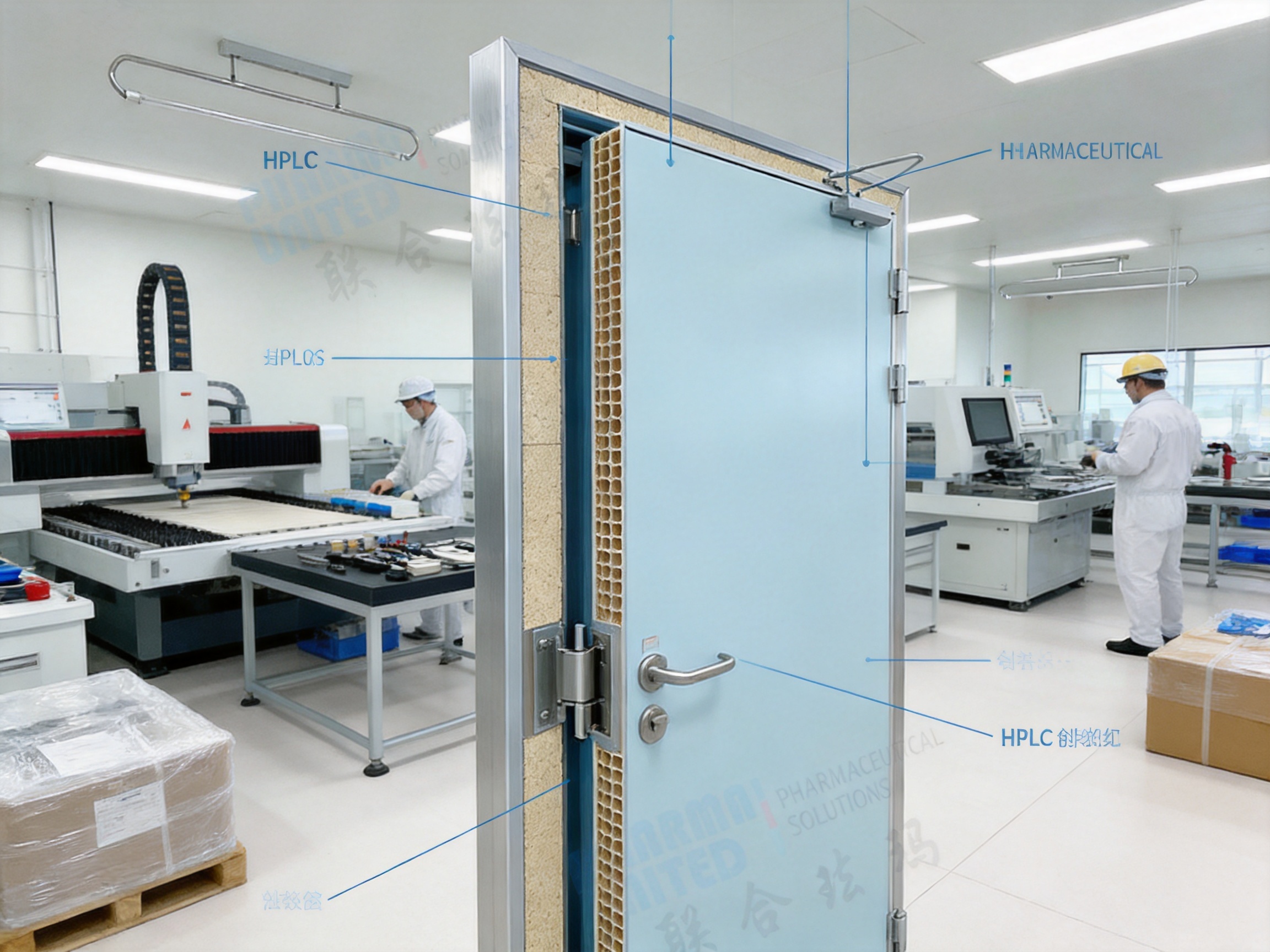
Manufacturing Strengths and Quality Control
The performance of a cleanroom door depends not only on the selected materials but also on manufacturing accuracy. Small deviations in panel dimensions, frame squareness, hinge positions, or sealing surfaces can create installation difficulties and operational problems. A controlled manufacturing process helps convert the design concept into a reliable finished product.
Engineering Review Before Production
Manufacturing begins with a review of the customer’s drawings, door schedule, cleanroom classification, wall system, traffic pattern, hardware requirements, and installation conditions. This stage identifies conflicts before fabrication. Engineers can confirm opening dimensions, swing directions, frame depths, hardware clearances, and the need for vision panels or interlocks.
For complex projects, door information can be coordinated with BIM visualization and the wider cleanroom model. This approach helps verify circulation, equipment access, maintenance space, and interfaces between doors, partitions, ceilings, and building services.
Material Preparation
Steel sheets, HPL sheets, infill materials, frame components, seals, and hardware are prepared according to approved specifications. Material control is important because variations in thickness, flatness, surface quality, or compatibility can affect the final assembly.
HPL sheets should be stored and handled correctly to avoid damage before bonding or assembly. Steel components should be inspected for dimensional accuracy and surface condition. The selected adhesive, sealant, and edge materials must be appropriate for the intended environment and the manufacturer’s process.
Precision Fabrication
Frame and panel components are cut and formed according to production drawings. Accurate equipment and standardized work instructions help maintain repeatability across different door sizes. Corners, edges, hinge reinforcements, lock preparations, and closer supports require special attention because they influence field installation and long-term operation.
Welding and joining procedures should produce strong, clean, and consistent connections. Excessive weld irregularity or unfinished joints can create contamination traps or interfere with the cleanroom partition. After fabrication, visible surfaces and connection areas are inspected for defects and corrected where necessary.
HPL Surface Application
The HPL surface must be bonded or mechanically integrated with care. Proper substrate preparation, adhesive distribution, pressure, temperature, and curing time all influence bond quality. A well-controlled process helps reduce bubbling, delamination, edge lifting, and surface unevenness.
After application, the door face is checked for visual defects, alignment, edge quality, and surface continuity. The finished face should be smooth and suitable for routine cleaning. Particular attention is paid to corners and edges because these areas are most likely to experience impact or moisture exposure.
Assembly and Hardware Preparation
The panel, frame, infill, hinges, locks, seals, handles, closers, and other components are assembled or prepared according to the approved configuration. Hardware positions must be consistent so that doors can be installed efficiently and adjusted correctly on site.
When access control or interlocking is required, the door can be prepared for the relevant electrical and mechanical components. Coordination at the factory stage reduces the need for uncontrolled cutting or modification at the project site.
Inspection and Packing
Finished doors should be checked for dimensions, squareness, surface condition, hardware operation, frame alignment, and packaging protection. Customized products are labeled according to the door schedule to support efficient site installation.
Careful packing is important because cleanroom doors can be damaged during transport if corners, HPL faces, hardware, and frame surfaces are not adequately protected. The company’s manufacturing and logistics capabilities support international project delivery, including large-volume shipments and coordinated export packaging.
Company Manufacturing and Project Capabilities
Pharma United Co., Ltd. is a cleanroom solution provider with its own manufacturing facility and experience in turnkey projects. The company’s product range includes metallic sandwich panels, HPL panels, cleanroom doors and windows, HVAC systems, and cleanroom equipment. This product integration allows doors to be designed alongside the partitions and environmental systems that surround them.
The company reports more than 20 years of industry experience, a factory area of approximately 20,000 square meters, more than 60 employees, and annual output exceeding 1,000 40HQ containers. The Kunshan factory expanded in 2026, doubling its previous production capacity. These capabilities support both standard product supply and customized project manufacturing.
The business developed through a series of corporate and manufacturing stages, including the development of Shanghai Sinoarch Co., Ltd. in 2006, CESE International Co., Ltd. in 2014, the Kunshan factory and Pharma United Co., Ltd. in 2016, and a branch factory in Qianjiang, Hubei, in 2022. This background contributes to the company’s accumulated experience in cleanroom materials and engineering delivery.
Pharma United’s engineering team has more than 10 years of average on-site experience. The team supports BIM visualization, technical coordination, and full installation services. Projects have been delivered in Africa, the Middle East, South Asia, and other international markets, including facilities associated with multinational pharmaceutical companies and industrial manufacturers.
The company’s strength is therefore not limited to supplying a door leaf. Customers can obtain design assistance, material coordination, manufacturing, shipping support, installation, and after-sales communication from a single cleanroom-focused supplier. This integrated approach can reduce interface problems between the door, partition, ceiling, HVAC, and process layout.
Installation Considerations
Correct installation is essential to achieving the intended performance of a cleanroom door. Before installation, the opening should be checked for dimensions, plumb, level, structural support, and compatibility with the frame. The surrounding wall panels should be installed according to the approved cleanroom layout and should not impose unintended loads on the door frame.
The frame must be aligned accurately in three dimensions. If the frame is twisted or out of square, the door may not close evenly, seals may not contact correctly, and the hardware may wear prematurely. Fixings should be appropriate for the wall system and should be installed according to the engineering drawings.
After the panel is hung, the hinges, closer, latch, seals, and lock should be adjusted. The door should open and close smoothly without excessive force. The gap around the door should be consistent, and the seals should make reliable contact when the door is closed. Where the door forms part of an airlock, the interlock sequence and access-control logic should be tested before handover.
Installation teams should protect the HPL surface from construction dust, welding sparks, impact, and aggressive cleaning chemicals. The final cleaning should be performed using materials approved for the HPL finish and the cleanroom’s sanitation procedure.
Operation and Maintenance
Routine maintenance begins with regular visual inspection. Facility personnel should check the surface, edges, frame, hinges, closer, lock, seals, handles, and vision panel if installed. Damage should be recorded and repaired before it affects cleanability or door operation.
Cleaning should follow the facility’s approved standard operating procedure. Use a clean, soft cloth or suitable non-abrasive pad with the approved cleaning solution. Avoid steel wool, highly abrasive powders, uncontrolled solvent use, and prolonged exposure to chemicals that have not been confirmed as compatible with HPL.
Hardware should be checked periodically for loose fasteners, abnormal noise, excessive closing force, or incomplete latching. Hinges and moving components should be serviced according to the hardware manufacturer’s recommendations. If the door is used in a pressure-controlled area, the seal condition should be inspected because worn seals can increase leakage.
Doors in high-traffic locations may benefit from protective kick plates, push plates, or impact guards. Such accessories should be designed and installed without creating difficult-to-clean ledges or compromising the cleanroom surface.
How to Select the Correct Configuration
The first step is to define the room function. A personnel door in a gowning room may have different requirements from a material-transfer door, operating-room door, laboratory door, or food-processing access door. The expected traffic, cleaning method, pressure difference, humidity, temperature, and chemical exposure should all be considered.
The second step is to confirm the opening size and wall construction. The door frame must be compatible with the cleanroom panel thickness and the installation method. Door dimensions should account for equipment movement, cart turning radius, emergency access, and maintenance requirements.
The third step is to determine whether a vision panel is necessary. The listed standard configuration has no glazing window. If supervision, safety, or process visibility requires glass, a flush and properly sealed vision panel can be reviewed as a custom option.
The fourth step is to select hardware and access control. Options may include stainless steel handles, concealed or suitable hinges, door closers, electromagnetic locks, card readers, keypad systems, panic hardware, and interlocking controls. The hardware should meet the hygiene, security, and operational requirements of the room.
The final step is to confirm cleaning and compliance requirements. The project team should identify applicable pharmaceutical, healthcare, food, building, fire, electrical, and occupational-safety standards before production. A complete technical submittal should include drawings, finish information, hardware schedules, installation details, and maintenance recommendations.
Frequently Asked Questions
What is the main advantage of a Cleanroom HPL Door?
Its main advantage is the combination of a durable, cleanable HPL surface with a steel-based cleanroom door structure. The product is designed to resist impact, scratches, corrosion-related surface deterioration, and routine cleaning demands.
Is the door suitable for pharmaceutical factories?
Yes. It is designed for pharmaceutical factories and other controlled environments. The final configuration should be selected according to the room classification, pressure requirements, cleaning chemicals, hardware standards, and applicable project regulations.
Does the standard product include a glass window?
The listed standard configuration does not include a glazing window. A vision panel can be considered as a customized option when visibility or supervision is required. The size, glass type, frame, sealing, and cleanability should be confirmed during technical design.
What is the infill material?
The listed configuration uses paper honeycomb infill. This material provides a practical balance between low weight and structural support. Alternative infill materials may be evaluated when the project requires special fire, acoustic, moisture, thermal, or security performance.
Can the door be made to a non-standard size?
Yes. The product size is customized. Dimensions should be confirmed according to the cleanroom opening, wall thickness, equipment movement, traffic requirements, and hardware arrangement.
Can the door be used with an interlocking system?
The listed configuration does not include interlocking. Mechanical or electronic interlocking can be coordinated as an optional project feature. The door, access-control system, power supply, emergency release, and control logic should be designed together.
What makes this door different from an ordinary painted steel door?
The HPL surface is selected for improved durability, scratch resistance, cleanability, and appearance retention in demanding environments. The cleanroom-oriented design also gives greater attention to frame integration, sealing, hardware coordination, and controlled installation.
Is HPL resistant to every chemical?
No material should be assumed to resist every chemical. HPL performance depends on the specific substance, concentration, temperature, contact time, and cleaning method. The selected disinfectants and chemicals should be checked against the HPL manufacturer’s compatibility information.
Can the company provide installation?
Pharma United provides cleanroom engineering and on-site installation services. Installation scope should be confirmed according to the project location, schedule, drawings, and contract requirements.
How should the door be maintained?
Clean the surface with approved non-abrasive materials, inspect seals and hardware regularly, tighten loose components, and repair damage promptly. Maintenance should follow the facility’s sanitation procedure and the recommendations for the selected HPL and hardware.
Which industries can use this product?
The door is suitable for pharmaceutical factories, laboratories, hospitals, operating rooms, food workshops, medical-device production, electronics manufacturing, and other controlled or hygienic environments.
What information is needed for a quotation?
Useful information includes door quantity, opening dimensions, wall thickness, room classification, swing direction, surface color, glazing requirements, hardware, access control, interlocking, cleaning conditions, delivery location, and installation scope.
Conclusion
The Cleanroom HPL Door is a practical solution for facilities that need a durable, hygienic, and customizable access door. Its HPL surface supports easy cleaning and resistance to routine impact, scratching, abrasion, and surface deterioration. Its steel frame, steel panel, and paper honeycomb infill provide a balanced construction for frequent-use areas, while customized dimensions allow the door to integrate with different cleanroom layouts.
The product is especially valuable because it can be evaluated as part of a complete cleanroom system. Door performance depends on the surrounding wall, frame, seals, hardware, pressure relationship, access control, and installation quality. By coordinating these elements through engineering review and factory production, project owners can reduce installation risks and improve long-term reliability.
Pharma United Co., Ltd. adds value through its manufacturing facility, broad cleanroom product range, international project experience, engineering support, BIM coordination, and installation capabilities. Its production scale and expanded Kunshan facility support customized orders and large project requirements, while its cleanroom-focused experience helps customers select suitable materials and configurations.
For pharmaceutical, healthcare, laboratory, food, and industrial applications, the Cleanroom HPL Door offers a strong combination of surface performance, structural stability, customization, and project support. When properly specified, manufactured, installed, and maintained, it can contribute to a cleaner, more efficient, and more dependable controlled environment.
References
1. ISO 14644 Series, Cleanrooms and Associated Controlled Environments.
2. Good Manufacturing Practice Guidelines for Pharmaceutical Production and Quality Control.
3. Guidelines for the Design and Operation of Hospital and Healthcare Clean Areas.
4. High-Pressure Decorative Laminate Material and Surface-Care Technical Guidance.
5. Cleanroom Design, Construction, and Commissioning Engineering Practices.
6. Manufacturer Technical Information for Cleanroom Doors, Frames, Seals, and Hardware.
7. Pharmaceutical Facility Planning and Contamination-Control Engineering Principles.
Product: Cleanroom HPL Door



-
Mobile
+86-177 1554 8238
-
E-mail
chin@pharma-united.com
-
Address
No.58 Beiyuan Road, Dianshanhu Town, Kunshan City, Jiangsu Province, China
Copyright © Pharma United Co., Ltd. Rights Reserved.
OEM/ODM Cleanroom Engineering Solution Manufacturers
