

 English
 русский
 Français
 Español
 عربى

Pass Box Solutions for Reliable Cleanroom Material Transfer
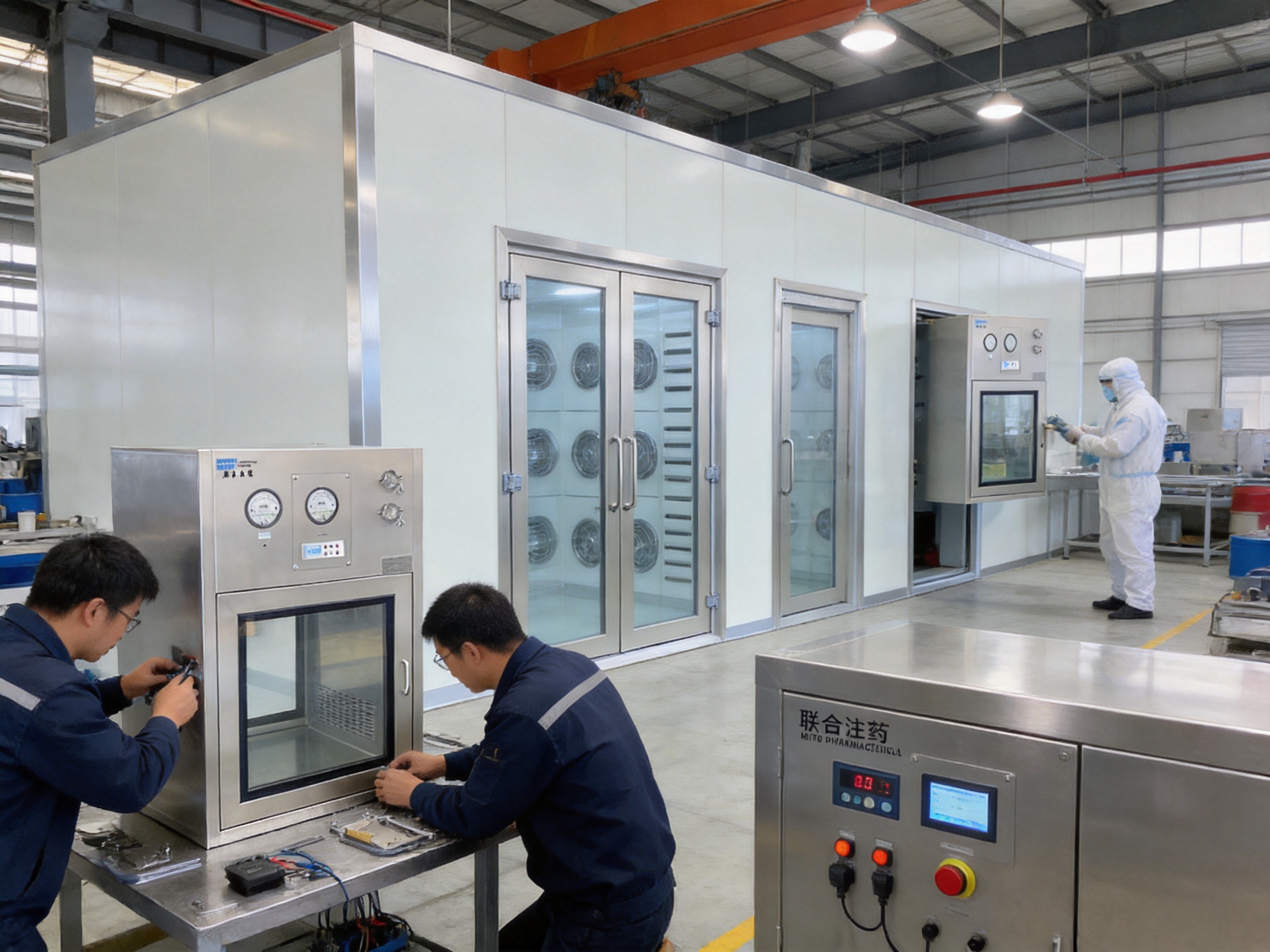
Material transfer is one of the most important activities in a controlled environment. Every item entering or leaving a cleanroom can affect cleanliness, workflow efficiency, and product protection. If materials are moved through ordinary doors, frequent door opening may disturb pressure relationships, increase air exchange, and create opportunities for contamination. A pass box provides a dedicated transfer route that helps separate material movement from personnel movement while supporting more stable cleanroom operations.
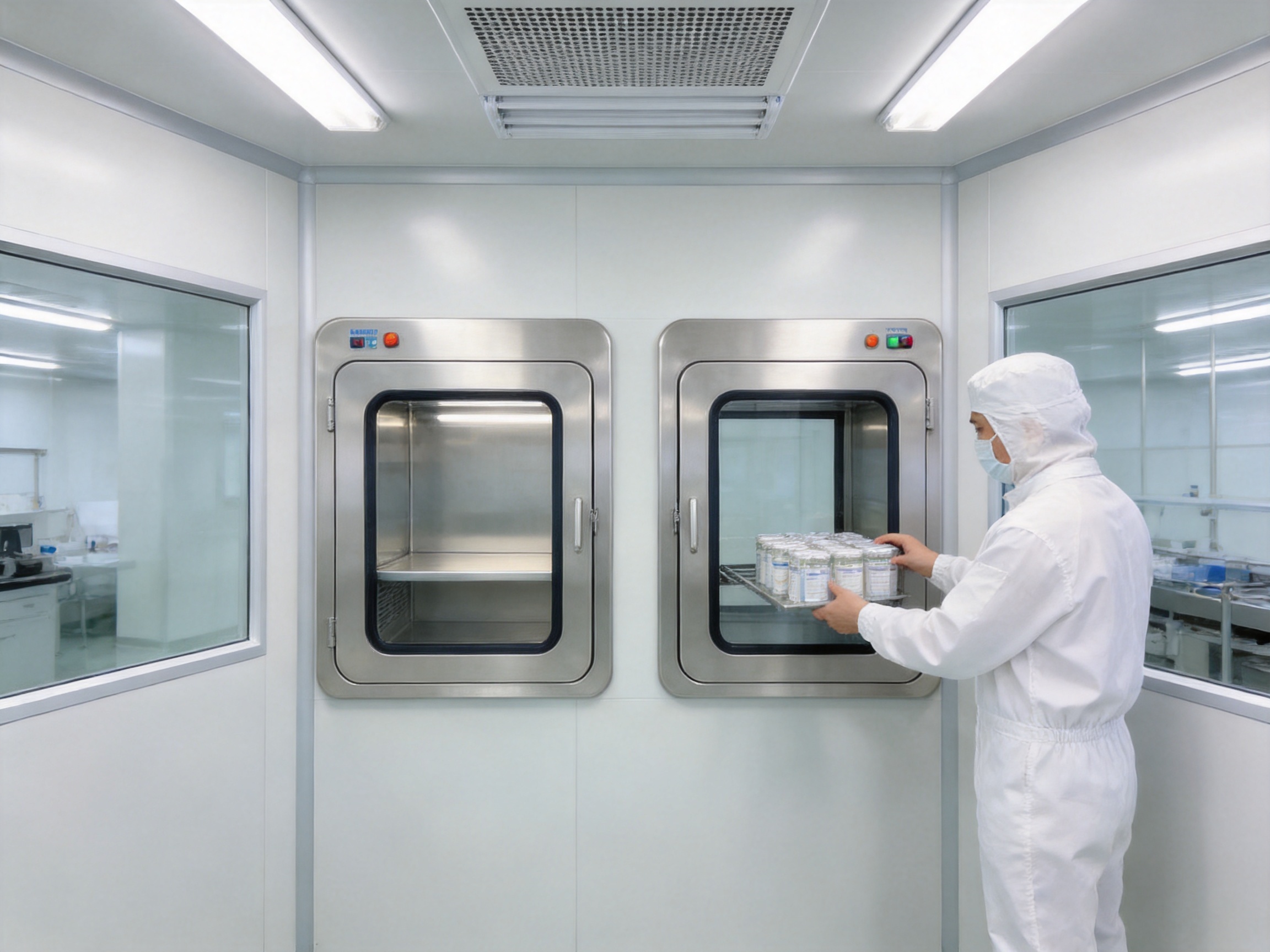
A pass box is a cleanroom transfer unit installed between two areas with the same or different cleanliness levels. It normally consists of an enclosed chamber with interlocked doors on opposite sides. Materials are placed inside the chamber through one door, the door is closed, and the opposite door can then be opened according to the operating procedure. This arrangement helps reduce unnecessary traffic and limits the direct connection between adjacent spaces.
Pharma United Co., Ltd. provides cleanroom pass box solutions for pharmaceutical factories, laboratories, hospitals, food processing workshops, electronics manufacturing facilities, and other controlled environments. The company can supply static pass boxes and dynamic pass boxes, with configurations developed according to the application, room classification, transfer volume, available space, and customer operating requirements.
What Is a Cleanroom Pass Box?
A pass box is a small enclosed transfer chamber used to move components, tools, samples, documents, packaging materials, and other items between cleanroom areas or between a cleanroom and a less-controlled area. It is not intended to replace the main cleanroom air-handling system. Instead, it complements the cleanroom by providing a controlled interface for material transfer.
The basic design includes an internal chamber, an external frame, two access doors, door seals, hardware, and an interlocking arrangement. The doors are positioned on opposite sides so that operators in adjacent rooms can access the same transfer chamber without opening both doors at the same time. Depending on the model, the unit may also contain a filtration system, fan, airflow monitoring device, differential pressure gauge, lighting, ultraviolet equipment where appropriate, or programmable control functions.
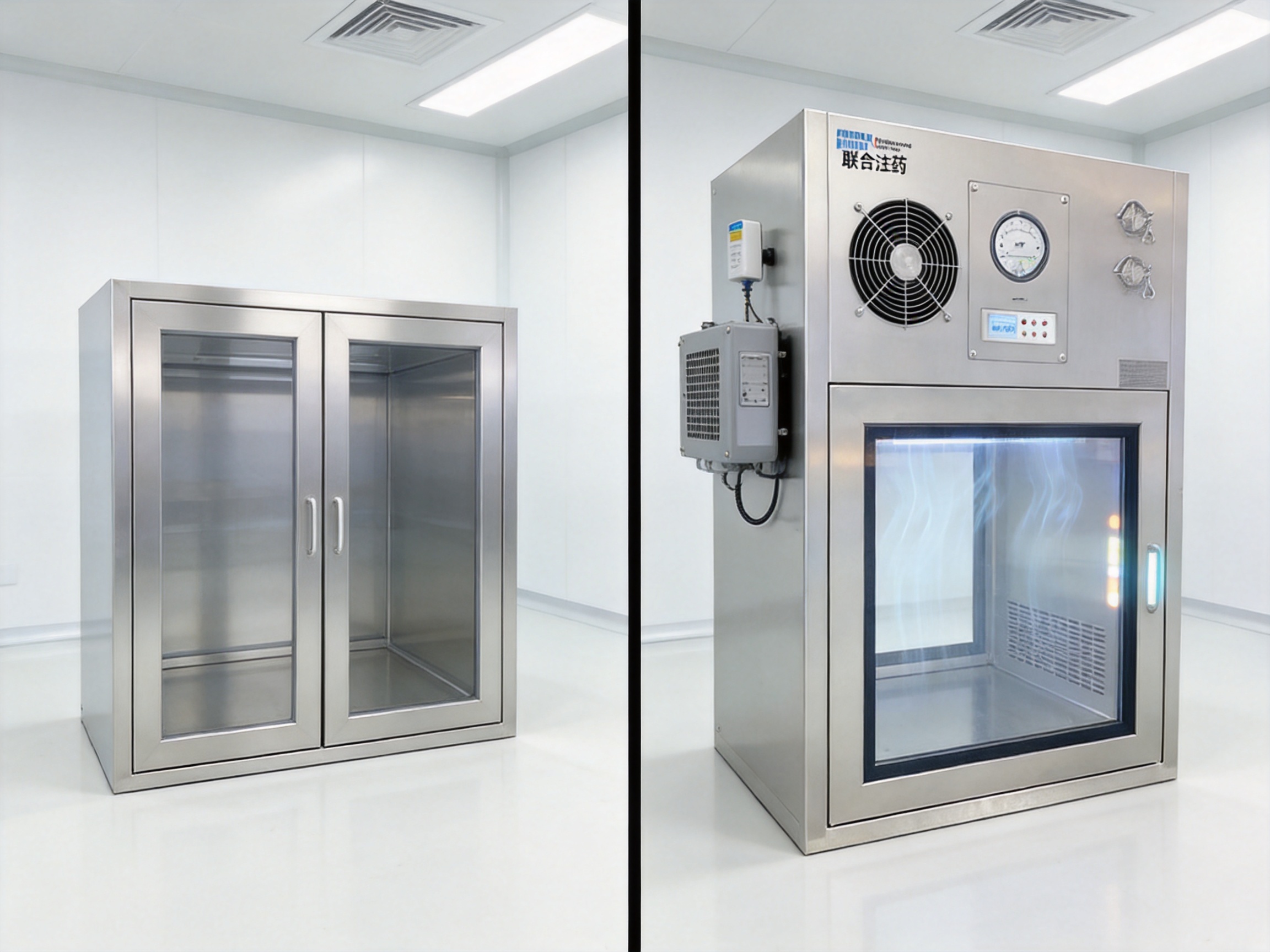
Static pass boxes are generally used when the principal objective is to reduce direct door opening and limit uncontrolled air exchange. They are suitable for many applications in which the transferred materials are already clean or are handled under an established cleaning procedure.
Dynamic pass boxes include an air circulation and filtration system. Air is continuously or periodically circulated through a filter to improve the internal chamber environment before, during, or after transfer. Dynamic designs are often selected for applications requiring a higher level of internal air control, improved particle management, or a more controlled transfer procedure.
The final selection should be based on the cleanroom classification, material characteristics, transfer frequency, cleaning method, pressure cascade, validation strategy, and applicable facility procedures. A pass box is most effective when its mechanical design and operating procedure are considered together.
Why Pass Boxes Are Important in Controlled Environments
Traditional personnel doors are not ideal for frequent material movement. Each opening can affect room pressure, airflow direction, temperature, humidity, and particle distribution. Repeated opening also increases the possibility that operators will carry contaminants between areas. When materials are moved through a dedicated pass box, the personnel door can remain closed and the movement pattern becomes more controlled.
A pass box can support several important cleanroom objectives:
First, it reduces the frequency of large door openings. The chamber is considerably smaller than a room entrance, so the amount of air exchanged during material transfer can be reduced.
Second, it helps maintain room segregation. The interlocking doors are designed to prevent both sides from being opened simultaneously during normal operation.
Third, it improves workflow organization. Materials can be transferred through a dedicated point rather than carried through corridors or personnel airlocks.
Fourth, it supports contamination-control procedures. Operators can clean or disinfect the chamber and transferred items according to documented site procedures.
Fifth, it can improve productivity. When properly positioned, a pass box shortens transfer routes and reduces the need for operators to enter or leave controlled rooms only to deliver small items.
Finally, a pass box provides a practical interface between rooms with different cleanliness requirements. It may be installed in walls, partitions, or specially designed transfer areas, depending on the project layout.
Static Pass Box and Dynamic Pass Box
Static Pass Box
A static pass box has no dedicated fan-and-filter air circulation system. Its main functions are physical separation, door interlocking, and controlled material transfer. The internal chamber is normally manufactured from smooth, cleanable materials such as stainless steel or coated panel systems.
Static units are often suitable for transferring items between rooms that have compatible cleanliness requirements or for applications in which the items are cleaned before entry. They can also be used where the facility already has a robust cleaning and disinfection process and does not require active air circulation inside the chamber.
The absence of a fan and filter can make a static pass box simpler to maintain and potentially more economical to install. It also reduces the number of components that require inspection, replacement, or qualification. However, the unit must still be used with appropriate cleaning procedures and should not be treated as a substitute for material decontamination.
Dynamic Pass Box
A dynamic pass box contains an air circulation system, normally consisting of a fan, filter assembly, airflow path, and control elements. The system circulates air within the chamber and may be configured to provide filtered air under positive pressure relative to the surrounding area, depending on the design requirements.
Dynamic models can provide improved control of airborne particles inside the chamber. They are often considered for pharmaceutical production, microbiology laboratories, sterile support areas, electronics manufacturing, and other applications where the transfer process requires additional environmental control.
The filter type, airflow volume, pressure relationship, fan selection, control method, and monitoring devices should be determined during project design. The correct specification depends on the room pressure cascade and the cleanroom classification. A dynamic pass box should be integrated into the facility's HVAC and contamination-control strategy rather than selected as an isolated piece of equipment.
Comparison of Static and Dynamic Designs
| Feature | Static Pass Box | Dynamic Pass Box |
| Main function | Controlled transfer with physical separation and interlocking | Controlled transfer with physical separation, interlocking, and filtered air circulation |
| Fan and filter | Normally not included | Included according to the required configuration |
| Typical application | Material transfer where cleaning procedures and room controls are sufficient | Transfer requiring additional internal air control and particle management |
| Maintenance | Generally simpler, with fewer mechanical components | Requires inspection of fan, filter, controls, and airflow performance |
| Design flexibility | Suitable for basic or moderate transfer requirements | Suitable for more demanding transfer procedures and controlled environments |
| Project considerations | Door interlock, chamber finish, seals, dimensions, and installation interface | All static-unit considerations plus filter selection, airflow, pressure, monitoring, and validation |
Neither type is universally better for every facility. A static unit may be the most appropriate solution for a simple transfer point, while a dynamic unit may be preferred when active air filtration is required. The better choice is the one that matches the contamination-control risk, operating procedure, and project budget.
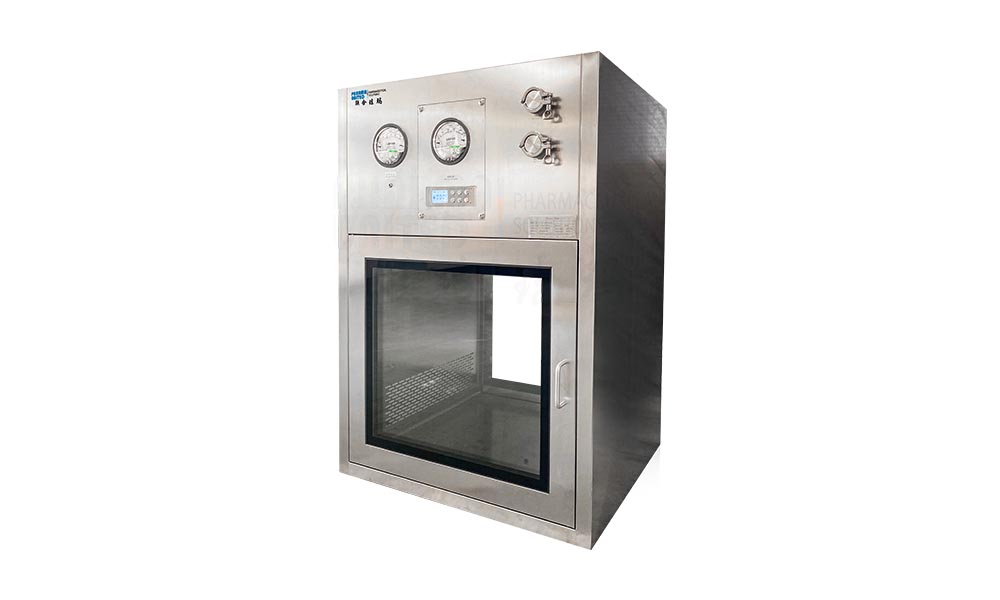
Pass Box
Key Product Features
Stainless Steel Construction
The standard main material specified for this pass box is SS304 stainless steel. Stainless steel is widely used in cleanroom equipment because it offers a smooth surface, good corrosion resistance, and convenient cleaning characteristics. Its non-porous finish helps reduce the accumulation of dust and residues when the surface is correctly fabricated and maintained.
SS304 can be used for the internal chamber, door surfaces, shelves, frames, or other parts according to the selected design. The specific material thickness, surface finish, edge treatment, and construction method should be confirmed during technical development. For more aggressive chemical environments, the project team may evaluate alternative materials or surface treatments.
Customized Dimensions
The pass box is available with customized dimensions. This is important because transfer requirements vary significantly among facilities. A laboratory may need a compact chamber for small containers, while a pharmaceutical production area may require a larger chamber for trays, packaging components, tools, or equipment parts.
Customization can include external width, height, depth, internal clear opening, chamber volume, shelf arrangement, door configuration, installation frame, and service access. The dimensions should be coordinated with the wall thickness, panel system, ceiling height, operator reach, trolley dimensions, and the largest item expected to be transferred.
Correct sizing is more than a matter of convenience. An oversized chamber may occupy valuable wall space and increase the internal air volume that must be controlled. An undersized chamber may encourage operators to force materials through the opening or bypass the intended procedure. The ideal size supports the actual transfer task while preserving convenient cleaning and maintenance access.
Interlocked Doors
Interlocking is a central safety and contamination-control feature. The two doors are designed so that opening one door prevents the other door from being opened under normal operating conditions. The interlock may be mechanical, electrical, or a combination of both.
Door interlocking helps prevent a direct open path between the two rooms. Depending on the control configuration, the pass box may include status indicators, audible alarms, emergency release functions, and access controls. The exact arrangement should be selected according to the facility's standard operating procedures and safety requirements.
Interlocks do not eliminate the need for operator training. Personnel should understand how to load materials, close the first door, wait for any required transfer cycle, and open the receiving-side door only when the procedure permits. A clear operating sequence is essential for reliable performance.
Cleanable Internal Surfaces
The internal chamber should be designed for routine cleaning and disinfection. Smooth surfaces, sealed joints, rounded or accessible corners, and limited exposed ledges can make cleaning more effective. The internal construction should minimize areas where particles, liquid residues, or packaging fragments can collect.
Cleaning agents should be compatible with the selected stainless steel grade, seal materials, door gaskets, and any internal accessories. The facility should establish the approved cleaning method, contact time, wiping procedure, and drying requirements. The pass box design can then be reviewed to ensure that the procedure is practical.
Configurable Equipment
The standard product information identifies the filter, fan, airflow sensor, differential pressure gauge, and PLC as configurable rather than fixed standard components. This approach allows the unit to be adapted to different applications.
For a static pass box, the filter, fan, airflow sensor, and PLC may not be required. For a dynamic pass box, these components can be incorporated according to the project requirements. A differential pressure gauge may be added when pressure monitoring is necessary. An airflow sensor may be used where the project requires confirmation of airflow performance or an alarm signal.
Configurable equipment can be an advantage because it avoids forcing every customer into the same design. A small laboratory transfer unit does not necessarily need the same controls as a high-volume pharmaceutical manufacturing facility. By developing the equipment around the application, the customer can balance performance, maintainability, and cost.
Advantages Compared with Basic Transfer Cabinets
Many basic transfer cabinets provide only a box and two doors. Although such a cabinet may be sufficient for low-risk movement, it may not offer the same level of integration, customization, or engineering support as a purpose-designed cleanroom pass box.
Better Integration with Cleanroom Layouts
A professionally designed pass box is developed with the surrounding cleanroom wall, ceiling, floor, and service systems in mind. The installation interface can be coordinated with cleanroom panels and architectural details. This reduces the risk of poorly sealed joints, incompatible dimensions, or difficult maintenance access.
More Appropriate Material Selection
The use of SS304 as the main material provides a practical balance of cleanability, durability, and cost for many cleanroom applications. The internal and external materials can be reviewed according to exposure conditions, cleaning agents, and project standards.
Greater Configuration Flexibility
A configurable product can be supplied as a static or dynamic unit. It can also be adapted to different dimensions and control requirements. This is more flexible than a standard cabinet that offers only one size, one door arrangement, or one fixed equipment package.
Improved Transfer Discipline
Interlocked doors and clear operating controls encourage a defined transfer sequence. This supports more consistent behavior among operators and helps reduce the chance of both doors being opened at the same time.
Support for International Projects
Pharma United serves customers in Africa, the Middle East, South Asia, and other international markets. Experience with different project environments can be valuable when coordinating dimensions, documentation, shipment, installation, and local site conditions.
Connection to a Complete Cleanroom Solution
A pass box is only one element of a controlled facility. Pharma United also manufactures or supplies metallic sandwich panels, HPL panels, cleanroom doors and windows, HVAC systems, and other cleanroom equipment. This broader product range can simplify coordination when the pass box must be installed as part of a complete cleanroom project.
Manufacturing and Engineering Strengths
Pass box performance depends not only on the selected components but also on manufacturing accuracy. Door alignment, frame flatness, seal compression, internal finish, weld quality, and installation interfaces can all affect practical performance. A supplier with its own manufacturing resources can coordinate these details more directly.
Dedicated Manufacturing Capability
Pharma United operates its own manufacturing facility and has more than 20 years of industry experience. The company reports a factory area of approximately 20,000 square meters, more than 60 staff members, and annual output exceeding 1,000 40HQ containers. These resources support the production of cleanroom products for both individual equipment orders and larger turnkey projects.
Production scale can improve material planning and delivery coordination, particularly when pass boxes are ordered together with cleanroom panels, doors, windows, and HVAC-related components. It can also support repeat production for customers operating multiple facilities or standardized room modules.
Process Control from Design to Fabrication
A reliable manufacturing process begins with a clear technical specification. Before fabrication, the supplier and customer should confirm the pass box type, dimensions, materials, door configuration, interlock method, equipment package, electrical requirements, finish, installation method, and documentation needs.
Engineering drawings can then be prepared for review. These drawings should show the external dimensions, internal clear opening, door swing or sliding arrangement, service connections, mounting details, and any filter or fan access panels. For dynamic units, airflow direction and component locations should also be reviewed.
After design approval, material preparation and fabrication can proceed. Sheet metal cutting, forming, welding, grinding, polishing, frame assembly, door installation, gasket fitting, hardware installation, and electrical integration should be controlled as connected operations rather than isolated tasks.
Welding and Surface Treatment
Cleanroom equipment requires attention to weld continuity and surface condition. Irregular welds, sharp projections, unsealed gaps, and rough grinding can make cleaning more difficult. Proper fabrication aims to create smooth and accessible surfaces that are compatible with the intended cleaning procedure.
Where stainless steel is used, the fabrication process should protect the material from unnecessary contamination and damage. The selected surface treatment should be consistent with the customer's expectations and the final application. Any visible defects, scratches, dents, or unfinished edges should be identified and corrected before shipment.
Door and Seal Assembly
The doors are among the most important moving components in a pass box. They must close properly, maintain alignment, and compress the seals consistently without excessive operating force. Door hinges, latches, handles, magnetic components, or other hardware should be selected according to the unit size and frequency of use.
Seal installation requires particular care. A damaged, twisted, incorrectly sized, or unevenly compressed gasket can affect cleanliness and interlock reliability. During quality inspection, the doors should be checked for smooth operation, proper closure, and acceptable contact around the perimeter.
Control and Electrical Integration
For dynamic pass boxes, the fan, filter, sensor, indicator, controller, and alarm functions should be assembled and checked as a system. The control panel should be arranged so that operators can understand the door status and operating condition. Maintenance personnel should have reasonable access to serviceable components.
A PLC may be included when the project requires programmable sequences, alarm logic, timing functions, data interfaces, or integration with a broader building management system. A simpler control arrangement may be adequate for applications with basic interlock requirements. The control design should avoid unnecessary complexity while providing the functions required by the operating procedure.
Factory Inspection
Factory inspection can include dimensional verification, visual inspection, door operation testing, interlock testing, electrical safety checks, fan operation checks, filter installation inspection, alarm verification, and documentation review. The inspection plan should reflect whether the unit is static or dynamic and whether special project requirements apply.
For dynamic units, airflow and pressure-related checks should be defined according to the selected fan and filter system. Final performance testing at the customer's site may also be necessary because installation conditions, room pressure, duct connections, and surrounding airflow can influence the result.
Design Considerations for Different Industries
Pharmaceutical Manufacturing
Pharmaceutical facilities often use pass boxes to transfer components, samples, tools, packaging items, and production accessories. The design may need to support strict cleaning procedures, material segregation, batch-related workflows, and documented transfer records.
A dynamic pass box can be considered where active filtered airflow is required. A static pass box may be suitable for certain support areas or for materials that are cleaned and wrapped before transfer. The final choice should be consistent with the facility's contamination-control strategy, room classification, and validation plan.
Laboratories
Laboratories may require pass boxes for samples, glassware, instruments, reagents, or protective equipment. Since laboratories often handle items of different sizes and types, internal dimensions and shelf arrangements should be selected carefully.
Where chemicals are transferred, material compatibility should be reviewed. Where biological samples are handled, the pass box should be integrated into the laboratory's biosafety and disinfection procedures. The pass box itself does not automatically neutralize biological or chemical hazards.
Hospitals and Healthcare Facilities
Healthcare applications may include sterile support areas, pharmacy departments, operating-room support spaces, preparation rooms, and isolation-related environments. The pass box can help control the movement of supplies while reducing unnecessary personnel traffic.
Ease of cleaning, reliable door operation, clear status indication, and simple maintenance are particularly important in healthcare facilities. The equipment should be selected in coordination with infection-control procedures and the room pressure arrangement.
Food Processing
Food processing facilities may use pass boxes to transfer ingredients, packaging, utensils, protective clothing, and inspection samples. Stainless steel construction is often attractive because it supports routine washing and sanitation when the selected materials and seals are compatible with the cleaning chemicals used on site.
The unit should be located where it supports hygienic zoning. Operators should be trained to clean both the transferred items and the chamber according to the site's sanitation program.
Electronics and Semiconductor Manufacturing
Electronics cleanrooms are sensitive to particles, fibers, and handling residues. Pass boxes can be used to transfer tools, components, packaging, and inspection materials while limiting unnecessary entry through personnel doors.
For these applications, the internal finish, particle-control strategy, grounding requirements, and material selection may require additional review. Dynamic air circulation may be considered when the process demands additional control within the chamber.
Installation Planning
Successful installation begins before the unit arrives at the site. The wall opening, panel thickness, support structure, electrical supply, and access route should be verified against the approved drawing. If the pass box is installed in a sandwich panel wall, the opening must be reinforced and sealed according to the panel system requirements.
The installation location should allow operators on both sides to load and unload materials comfortably. Adequate clearance should be provided for door movement, maintenance, filter replacement, electrical access, and cleaning. The position should not obstruct corridors, emergency routes, or other equipment.
For dynamic units, the electrical supply and any external service connections must be confirmed in advance. If the design includes a filter replacement access panel, the panel should remain accessible after installation. If the pass box is connected to a building monitoring system, signal types and communication requirements should be coordinated before commissioning.
After installation, the frame and doors should be checked for level, alignment, smooth operation, and proper sealing. The interlock should be tested from both sides. Dynamic units should be tested for fan operation, airflow direction, filter seating, alarm status, and any specified pressure or monitoring functions.
Operation and Cleaning Procedures
A pass box should be operated according to a written standard operating procedure. The procedure normally identifies the materials allowed in the chamber, the cleaning method, the loading sequence, the waiting period if applicable, the transfer authorization, and the response to alarms or interlock faults.
A typical transfer sequence is as follows:
1. Confirm that the receiving side is ready and that the pass box is clean.
2. Open the door on the originating side only.
3. Place the material inside the chamber without blocking the door seal or air path.
4. Close the originating-side door fully.
5. Complete any required cleaning, waiting, or air circulation cycle.
6. Confirm the permitted status indication.
7. Open the receiving-side door and remove the material.
8. Close the receiving-side door and restore the pass box to its normal condition.
The exact sequence may vary by facility. Operators should never force a door, bypass an interlock, or place materials in a way that blocks the fan intake, filter outlet, sensor, or door seal.
Cleaning frequency depends on the application and transfer volume. High-use pharmaceutical or laboratory facilities may clean the chamber at scheduled intervals and after specific types of transfer. The cleaning method should address the internal floor, side walls, ceiling, shelf, door surfaces, handles, gaskets, and any exposed control components.
Cleaning agents should be applied in a controlled quantity. Excess liquid should not be allowed to enter electrical components, fan assemblies, sensors, or control panels. After cleaning, the chamber should be allowed to dry as required by the procedure.
Maintenance Requirements
Routine maintenance helps preserve the performance of both static and dynamic pass boxes. Static units should be inspected for door alignment, gasket condition, interlock function, surface damage, loose hardware, and cleanliness.
Dynamic units require additional checks. These may include fan operation, filter condition, airflow performance, sensor function, differential pressure indication, alarm operation, and control-panel status. Filter replacement intervals should be based on operating conditions, pressure drop, inspection results, and the recommendations established for the installed filter.
Maintenance staff should record inspections and corrective actions. If a door does not close properly, an interlock remains active, an alarm occurs unexpectedly, or the internal finish is damaged, the unit should be assessed before continued use.
Preventive maintenance is generally more effective than waiting for a failure. Scheduled inspection can identify worn gaskets, loose hinges, blocked filters, damaged indicators, or deteriorating seals before they affect daily operations.
Quality, Documentation, and Project Support
For a cleanroom project, the product itself is only part of the purchasing decision. Customers may also require drawings, technical data, inspection records, installation instructions, operation manuals, spare-parts information, and maintenance recommendations.
Documentation should identify the model configuration, dimensions, materials, electrical requirements, filter information where applicable, fan information for dynamic units, and recommended operating conditions. Project-specific documents may also include inspection checklists, factory test records, and installation details.
Pharma United's engineering team has more than 10 years of average on-site experience. This practical background supports coordination between product manufacturing and site installation. The company also supports BIM visualization, which can help project teams review room layouts, equipment locations, service clearances, and material interfaces before construction.
For larger projects, the pass box can be coordinated with the overall cleanroom design and construction package. This may help reduce interface problems between the transfer unit, wall panels, cleanroom doors, HVAC systems, electrical services, and commissioning activities.
Why Choose a Customized Pass Box Manufacturer?
Standard products can be suitable for simple applications, but customized manufacturing offers several benefits when the cleanroom has specific requirements. A customized unit can match the transfer item size, panel thickness, room layout, pressure relationship, electrical standard, and cleaning procedure.
Customization also allows the customer to avoid unnecessary features. A static pass box may not need a PLC, airflow sensor, or fan. A dynamic pass box may require all three, along with a differential pressure gauge and a more detailed alarm system. Selecting only the necessary features can make the equipment easier to operate and maintain.
A manufacturer that provides both equipment and cleanroom construction products can also coordinate appearance and interfaces across the facility. Matching finishes, frames, hardware, and dimensions can contribute to a more integrated installation.
Pharma United was developed through the growth of Shanghai Sinoarch Co., Ltd., established in 2006, CESE International Co., Ltd., established in 2014, the Kunshan factory and Pharma United Co., Ltd., established in 2016, and a branch factory in Qianjiang, Hubei, established in 2022. In 2026, the Kunshan factory expanded to increase its previous production capacity.
This development reflects a manufacturing organization focused on cleanroom products, engineering coordination, and international project delivery. Its experience across pharmaceutical, healthcare, and industrial applications provides a foundation for adapting pass box designs to different project conditions.
How to Select the Right Pass Box
The following questions should be answered before ordering:
What materials will be transferred? Their dimensions, weight, packaging, fragility, and cleaning requirements will influence the chamber size and internal arrangement.
Between which areas will the pass box be installed? The cleanliness levels, pressure relationship, temperature, humidity, and personnel workflow should be reviewed.
Is active filtration required? If yes, the design should define the fan, filter, airflow, pressure, monitoring, and control requirements.
How frequently will the unit be used? High-frequency transfer may require durable hardware, clear indicators, and convenient maintenance access.
What cleaning agents will be used? The material, gasket, sealant, and surface finish should be compatible with the procedure.
How will the equipment be installed? The wall construction, opening size, frame, support, electrical supply, and service clearance should be confirmed.
What documentation is required? The project may need approved drawings, factory test records, material information, operating instructions, or commissioning support.
What is the long-term maintenance plan? Filter access, spare parts, gasket replacement, and service support should be considered from the beginning.
Q&A About Cleanroom Pass Boxes
What is the primary purpose of a pass box?
The primary purpose is to transfer materials between controlled areas while reducing unnecessary door opening, limiting direct air exchange, and supporting separation between rooms. It provides a dedicated route for material movement without requiring personnel to pass through the main cleanroom entrance.
What is the difference between a static and dynamic pass box?
A static pass box normally uses an enclosed chamber and interlocked doors without a dedicated fan-and-filter circulation system. A dynamic pass box adds filtered air circulation and may include airflow sensors, pressure gauges, alarms, and programmable controls. The appropriate type depends on the contamination-control requirements.
Is a dynamic pass box always better than a static pass box?
No. A dynamic unit provides additional air-control functions, but it also contains more components and requires more maintenance. A static pass box can be the better choice when materials are already clean, the transfer risk is controlled through procedures, and active filtration is not required.
Why is SS304 commonly used?
SS304 is widely used because it provides a smooth, durable, and corrosion-resistant surface for many cleanroom applications. It is generally easy to clean when properly fabricated and maintained. The final material choice should consider the cleaning chemicals, environmental conditions, and project specifications.
Can the pass box dimensions be customized?
Yes. The pass box is specified with customized sizing. Dimensions can be developed according to the largest material to be transferred, the available wall space, the operator's reach, the panel thickness, and the required internal arrangement.
Can a pass box be installed in a cleanroom partition?
Yes. It can be designed for installation in a cleanroom wall or partition, provided that the opening, support, frame, sealing, and panel interface are properly coordinated. The installation drawing should be reviewed before the wall is fabricated.
Does a pass box sterilize the materials inside it?
Not automatically. A pass box supports controlled transfer, but it should not be assumed to sterilize or decontaminate materials. Any cleaning, disinfection, sterilization, or waiting process must be defined by the facility's validated procedures and the selected equipment configuration.
Can a pass box include a filter and fan?
Yes. A dynamic pass box can be equipped with a fan and filter system. The filter type, airflow rate, pressure relationship, monitoring devices, and control functions should be determined according to the application and room classification.
What maintenance does a dynamic pass box require?
Maintenance may include fan inspection, filter condition checks, airflow verification, sensor testing, differential pressure monitoring, alarm testing, door and gasket inspection, and cleaning. The maintenance frequency should be established by the facility based on operating conditions and performance records.
Can the pass box be supplied as part of a complete cleanroom project?
Yes. Pharma United provides cleanroom panels, doors, windows, HVAC systems, equipment, and engineering services. This allows the pass box to be coordinated with a broader cleanroom design, construction, installation, and commissioning package.
What information should be provided when requesting a quotation?
Useful information includes the required pass box type, external and internal dimensions, material requirements, wall thickness, largest transfer item, transfer frequency, cleanliness levels, pressure relationship, static or dynamic operation, electrical standard, control requirements, installation location, delivery destination, and documentation requirements.
Conclusion
A pass box is a practical and important component of modern cleanroom design. By providing a dedicated material-transfer route, it can reduce unnecessary door opening, support room segregation, improve workflow, and contribute to contamination-control procedures. Static and dynamic configurations allow the equipment to be matched to different levels of operational need.
The pass box described here combines customized dimensions, SS304 construction, interlocked doors, cleanable surfaces, and optional equipment such as filters, fans, airflow sensors, differential pressure gauges, and PLC controls. This configurable approach allows pharmaceutical, laboratory, healthcare, food, electronics, and industrial customers to select a solution appropriate to their process.
Manufacturing quality remains essential. Accurate fabrication, reliable door assembly, proper sealing, controlled welding, appropriate surface treatment, and functional inspection all contribute to dependable operation. Pharma United's manufacturing resources, cleanroom product range, project experience, engineering team, factory capacity, and international delivery capability support the development of pass boxes for both standalone applications and complete cleanroom projects.
The best pass box is not simply the largest or most technically complex model. It is the unit that fits the material, the room, the transfer procedure, the contamination-control strategy, and the long-term maintenance plan. With proper design, installation, operation, and inspection, a pass box can provide a durable and efficient interface between controlled environments.
References
1. International Organization for Standardization. ISO 14644 series, Cleanrooms and Associated Controlled Environments.
2. International Organization for Standardization. ISO 14644-1, Classification of Air Cleanliness by Particle Concentration.
3. International Organization for Standardization. ISO 14644-4, Design, Construction and Start-Up.
4. International Society for Pharmaceutical Engineering. Baseline Guide: Sterile Product Manufacturing Facilities.
5. World Health Organization. Good Manufacturing Practices for Pharmaceutical Products.
6. United States Pharmacopeia. General chapters relating to sterile products, controlled environments, and environmental monitoring.
7. European Commission. EudraLex, Volume 4, Good Manufacturing Practice Guidelines.
8. Pharma United Co., Ltd. Product and company technical information supplied for cleanroom pass box applications.
Product: Pass Box



-
Mobile
+86-177 1554 8238
-
E-mail
chin@pharma-united.com
-
Address
No.58 Beiyuan Road, Dianshanhu Town, Kunshan City, Jiangsu Province, China
Copyright © Pharma United Co., Ltd. Rights Reserved.
OEM/ODM Cleanroom Engineering Solution Manufacturers
