

 English
 русский
 Français
 Español
 عربى

Cleanroom PCGI Doors: A Practical, Hygienic, and Cost-Effective Solution for Controlled Environments
Cleanroom doors are essential components of controlled environments. They separate rooms with different cleanliness classifications, support pressure-control strategies, protect production processes from contamination, and help operators move safely between manufacturing, testing, storage, and service areas. Although a door may appear to be a relatively small part of a cleanroom project, its construction, surface finish, sealing performance, durability, and maintenance requirements can strongly influence the long-term performance of the entire facility.
The Cleanroom PCGI Door is designed to provide a practical solution for pharmaceutical factories, laboratories, hospitals, food workshops, electronics cleanrooms, and other hygienically controlled spaces. PCGI refers to pre-coated galvanized iron or steel. In this door construction, galvanized steel sheets are finished with a factory-applied coating before being formed and assembled into the door panel. The result is a smooth, corrosion-resistant, easy-to-clean surface suitable for standard cleanroom applications.
This type of door combines a steel frame, a steel door panel, and a paper honeycomb infill. Its structure is straightforward, economical, and adaptable to different project requirements. Customized dimensions allow the door to be integrated into new cleanrooms, facility extensions, renovation projects, personnel airlocks, material transfer zones, laboratories, and general controlled production areas.
Compared with conventional painted doors, untreated metal doors, or ordinary commercial doors adapted for cleanroom use, a properly manufactured PCGI cleanroom door offers a more suitable surface, more consistent construction, and better compatibility with hygienic operating procedures. It is engineered for environments where smoothness, easy cleaning, stable appearance, and dependable daily use are more important than decorative complexity.
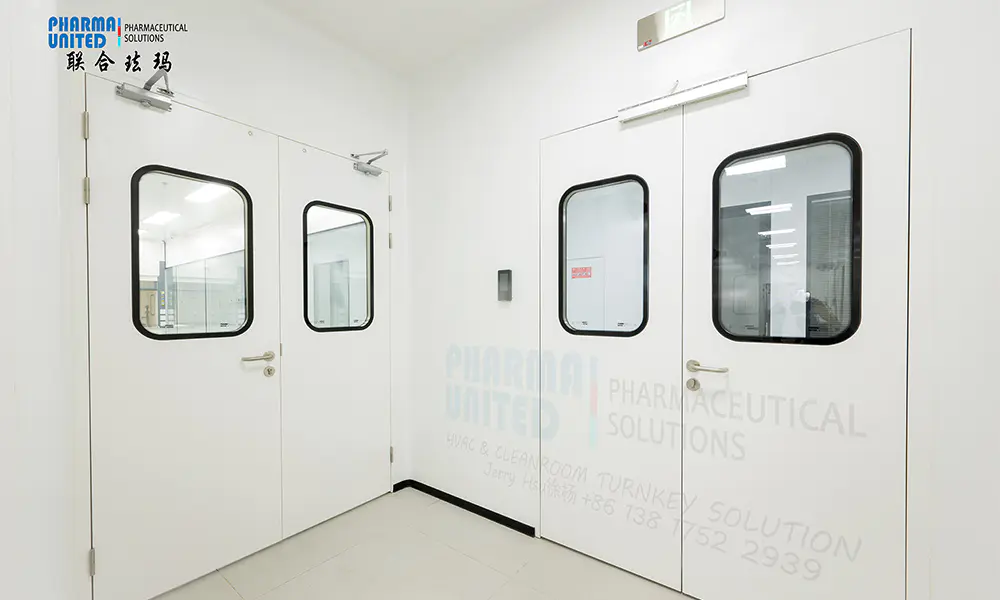
Cleanroom PCGI Door
What Is a Cleanroom PCGI Door?
A Cleanroom PCGI Door is a specialized door assembly manufactured with pre-coated galvanized steel sheets. The galvanized base material provides protection against corrosion, while the factory-applied coating creates a smooth and uniform external surface. This construction is intended to reduce the accumulation of dust and make routine cleaning easier.
The door frame is manufactured from steel, and the door panel is also made from steel. Inside the panel, paper honeycomb is used as the infill material. The honeycomb structure provides a lightweight internal core while helping the panel maintain its shape. It also supports efficient material usage and contributes to the cost-effective character of the product.
The standard product configuration does not include a glazing window, interlock, or specified color. These details can be reviewed according to the application and project design. The overall size is customized, allowing the door to be produced for different wall systems, room layouts, corridor widths, equipment routes, and access requirements.
The cleanroom door is intended to function as part of a complete cleanroom envelope. It may be installed in rooms with cleanable wall panels, ceiling systems, air-handling equipment, air showers, pass boxes, and other cleanroom components. To obtain the best performance, the door should be selected and installed together with a compatible wall thickness, frame detail, threshold arrangement, hardware package, and sealing method.
Why Door Selection Matters in Cleanroom Projects
Cleanroom performance depends on the cooperation of many elements. Air filtration, air changes, room pressure, temperature, humidity, personnel behavior, cleaning procedures, and building finishes all influence the cleanliness of a controlled area. Doors are part of this system because they are opened and closed repeatedly and are located at the boundary between rooms or between a controlled space and a less controlled environment.
An unsuitable door can create several problems. Rough surfaces may retain dust and biological residues. Unprotected steel can corrode after repeated contact with cleaning chemicals or humid air. Poorly fitted frames may create gaps that interfere with pressure control. Weak panels may become damaged by carts, trolleys, or frequent impact. Ordinary doors may also have unnecessary decorative features that are difficult to clean.
A cleanroom door must therefore be selected according to the actual operating environment. The correct product should provide a smooth surface, reliable structural integrity, practical maintenance, appropriate dimensions, and compatibility with the surrounding cleanroom construction. It should also be available in a configuration that supports the project budget and schedule.
The PCGI door addresses these needs with a simple and effective design. Its coated galvanized steel surfaces support hygiene and maintenance, while the steel frame and steel panel provide a robust foundation. The paper honeycomb core helps keep the construction economical without introducing an unnecessarily heavy door leaf for standard applications.
Core Product Specifications
The following table summarizes the available product configuration based on the supplied technical information. Final specifications should be confirmed during project design, because cleanroom door requirements may vary according to room classification, traffic intensity, wall construction, fire strategy, hardware selection, and local regulations.
| Parameter | Value |
| Product type | Cleanroom PCGI Door |
| Typical applications | Pharmaceutical factories, laboratories, hospitals, food workshops, and electronics cleanrooms |
| Size | Customized |
| Door frame | Steel |
| Door panel | Steel with pre-coated galvanized steel sheet surfaces |
| Infill | Paper honeycomb |
| Glazing window | Not included in the standard configuration |
| Color | To be confirmed according to project requirements |
| Interlock | Not included in the standard configuration |
This configuration is particularly suitable for projects that require dependable cleanroom access without the additional cost or complexity of a fully specialized door system. Where a vision panel, electronic interlock, special hardware, impact protection, or other feature is required, the door design can be reviewed during the engineering and quotation stages.
Pre-Coated Galvanized Steel Surface
The most important material feature of the door is the pre-coated galvanized steel sheet. Galvanization provides a protective zinc layer over the steel substrate. This layer helps reduce the risk of corrosion when the material is exposed to ordinary atmospheric moisture and routine operating conditions. The pre-coating then adds a smooth finished surface that is more suitable for cleanroom maintenance than unfinished steel.
Factory coating offers several advantages over field painting. The coating process can be performed under controlled production conditions, where surface preparation, coating application, drying, and inspection are easier to manage. Factory finishing also produces a more consistent appearance across multiple door leaves and frames. When doors are delivered for installation, the finished surfaces are ready for assembly and do not require painting inside the cleanroom area.
A smooth coating helps reduce the number of places where dust, powder, fibers, and residues can accumulate. It also supports the use of routine wiping and cleaning procedures. In pharmaceutical, laboratory, healthcare, and food-related environments, the ability to clean surfaces quickly and consistently is an important operational advantage.
The coating should still be selected and maintained in accordance with the cleaning chemicals and disinfectants used at the facility. No coating is completely immune to aggressive chemicals, abrasion, or impact. Operators should use approved cleaning agents, suitable cloths, and correct procedures to preserve the finish throughout the service life of the door.
Steel Door Frame and Door Panel Construction
The steel frame provides the supporting structure around the door opening. It helps maintain the geometry of the assembly and creates the interface between the door and the cleanroom wall. A properly manufactured frame also supports the installation of hinges, locks, closers, seals, and other operating hardware.
The steel door panel provides a stable and durable barrier between adjacent spaces. Steel is widely used in controlled environments because it offers good mechanical strength, dimensional stability, and compatibility with cleanable surface finishes. When properly coated, it can provide a practical balance between hygiene, durability, and cost.
The relationship between the frame and panel is important. Even a high-quality door leaf cannot perform correctly if the frame is distorted, incorrectly sized, or poorly installed. For this reason, manufacturing accuracy, dimensional control, and installation supervision are important parts of a complete cleanroom door solution.
The door assembly should be coordinated with the wall panel system. The wall thickness, panel joint detail, floor finish, ceiling height, and corridor arrangement all affect the final door installation. Early coordination reduces the risk of field modifications, uneven gaps, alignment problems, or damage to finished cleanroom surfaces.
Paper Honeycomb Infill and Practical Lightweight Design
Paper honeycomb is used as the internal infill of the standard door panel. Its cellular structure allows the panel to achieve useful rigidity with a relatively low material weight. This can simplify handling during installation and reduce the load placed on hinges and associated hardware in comparison with a much heavier solid construction.
A lightweight door can be beneficial in areas with frequent opening and closing. It can also make transportation, positioning, and installation more efficient. For a project with many doors, reducing unnecessary door weight may contribute to easier site logistics and lower installation effort.
The honeycomb infill is a practical choice for standard cleanroom applications where the door is not required to meet a specialized impact, ballistic, acoustic, or fire-resistance specification. If a project requires a different performance level, the internal construction should be reviewed before ordering. The correct infill depends on the door size, usage frequency, environmental conditions, regulatory requirements, and hardware arrangement.
The use of paper honeycomb also supports cost control. By using material where it contributes most effectively to the panel structure, the manufacturer can offer a more economical alternative to heavier and more complex door constructions. This makes the product suitable for large cleanroom projects where numerous access doors are required.
Hygiene and Ease of Cleaning
Hygiene is one of the primary reasons for selecting a cleanroom-specific door instead of a standard commercial door. The PCGI door has a smooth coated surface that supports routine cleaning and visual inspection. It is easier to wipe than many textured, porous, or heavily profiled surfaces.
In pharmaceutical and healthcare environments, doors may be cleaned several times per day or according to a defined sanitation schedule. Smooth surfaces help cleaning personnel work consistently across the door leaf, frame, and surrounding areas. They also make it easier to identify visible residues, stains, or damage that may require corrective action.
In food workshops, cleanability is especially important because organic residues, powders, moisture, and cleaning solutions may come into contact with doors. A corrosion-resistant coated surface can support better long-term appearance and maintenance when the correct cleaning program is followed.
Electronics cleanrooms may have strict controls over dust and particle generation. While a door alone cannot determine room cleanliness, a smooth, properly maintained door surface can contribute to a cleaner room envelope. The design avoids unnecessary decorative grooves or features that may become difficult to inspect and clean.
Cleaning staff should follow the facility’s approved standard operating procedures. Excessive scrubbing, sharp tools, unsuitable solvents, or highly concentrated chemicals may damage the coating. Periodic inspection should include the door edge, frame corners, hinges, lock areas, bottom section, and any seals or protective components.
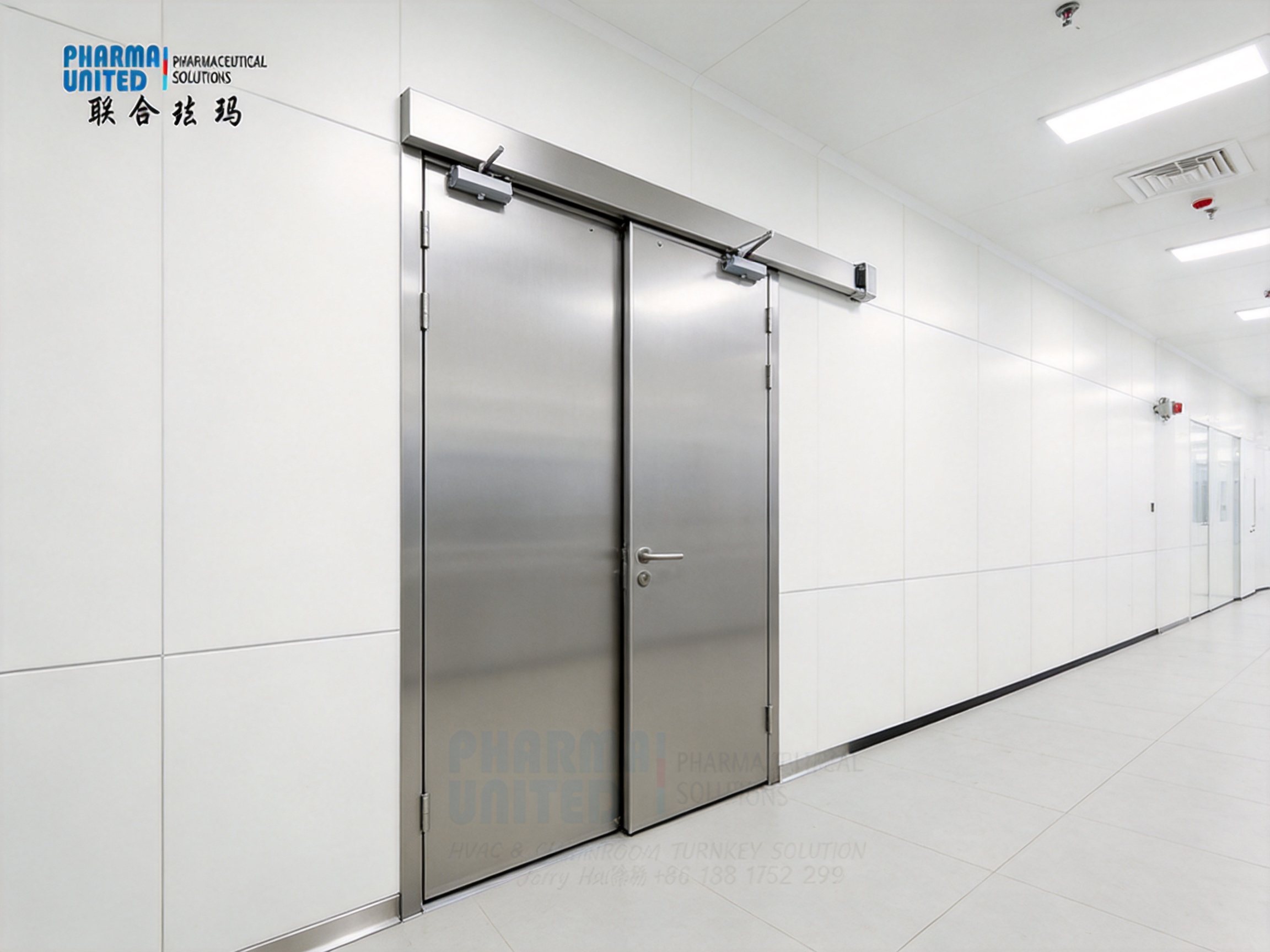
Applications Across Multiple Industries
Pharmaceutical Manufacturing
Pharmaceutical facilities use cleanroom doors between manufacturing rooms, preparation areas, corridors, laboratories, material airlocks, personnel airlocks, and storage zones. These doors help maintain the separation of areas with different cleanliness requirements and support the controlled movement of people and materials.
The PCGI door is suitable for standard GMP cleanroom areas where smooth finishes, easy maintenance, and stable performance are required. It can be used in production support rooms, changing areas, packaging zones, sampling rooms, and other locations where a practical hygienic door is needed.
Door selection in pharmaceutical facilities should be coordinated with pressure cascades, room classification, cleaning chemicals, equipment movement, and validation requirements. Where the project requires interlocking doors, vision panels, automatic operators, or specialized sealing, those options should be identified during the design stage.
Laboratories
Laboratories often contain a variety of rooms, including chemical preparation areas, microbiology rooms, testing laboratories, instrument rooms, sample storage spaces, and controlled access zones. A cleanable steel door can provide a consistent and professional finish across these areas.
Laboratory operators may require frequent cleaning and may use disinfectants or chemical agents. The coating system should therefore be matched with the laboratory’s cleaning protocol. The door’s customized size can also support different room layouts and equipment access requirements.
Hospitals and Healthcare Facilities
Hospitals require cleanable surfaces in operating departments, sterile processing areas, laboratories, isolation zones, pharmacies, and other controlled spaces. A steel cleanroom door can be used where a robust, smooth, and economical door solution is preferred.
Healthcare facilities also experience high traffic and frequent contact with door hardware. The hinges, locks, handles, closers, kick plates, and protective accessories should be selected according to the expected traffic level. A standard PCGI door is especially appropriate for controlled areas where the operating requirements do not demand a specialized automatic or hermetically sealed door.
Food Workshops
Food production environments require surfaces that can be cleaned regularly and maintained in a hygienic condition. The coated galvanized steel finish is suitable for many standard food workshop areas, especially where doors are exposed to moisture, cleaning routines, and regular movement between production rooms.
Food manufacturers should consider washdown intensity, humidity, temperature, cleaning agents, and potential contact with salts or acidic substances before selecting the final door configuration. Additional protection may be appropriate in areas where carts, pallets, or machinery could strike the lower part of the door.
Electronics Cleanrooms
Electronics production and assembly areas often require controlled particle levels, stable environmental conditions, and strict housekeeping. The smooth, coated surface of the PCGI door supports routine cleaning and helps maintain a neat cleanroom envelope.
The door may be used in assembly rooms, inspection areas, laboratories, material preparation spaces, and controlled corridors. Project designers should coordinate the door with electrostatic control measures, room pressure requirements, and the movement of sensitive products or equipment.
Advantages Over Conventional and Competing Door Options
The PCGI cleanroom door is not intended to replace every type of specialized cleanroom door. However, it offers a strong combination of features for standard applications. Its main competitive advantage is the balance between hygienic surface performance, structural practicality, customization, and cost.
Compared with Ordinary Painted Steel Doors
Ordinary painted steel doors may be produced for general building use and may not be designed for frequent cleanroom cleaning. Their surface quality can vary, and field-applied paint may be more vulnerable to uneven coverage, scratches, or premature deterioration.
A pre-coated galvanized steel door begins with a protected steel substrate and a controlled factory finish. This provides a more consistent surface and reduces the need for painting at the project site. The result is a cleaner installation process and more predictable appearance across a large number of openings.
Compared with Untreated Metal Doors
Untreated metal can corrode when exposed to moisture, condensation, cleaning agents, or humid production conditions. Corrosion may create rough areas that are more difficult to clean and may eventually affect the visual appearance and serviceability of the door.
The galvanized and coated construction provides a more appropriate level of protection for standard controlled environments. It does not eliminate the need for maintenance, but it provides a stronger starting point than bare steel.
Compared with Heavier Specialized Doors
Some cleanroom applications require hermetic doors, insulated doors, high-impact doors, lead-lined doors, fire-rated doors, or automatic sliding systems. These products may be essential in specialized locations, but they can be more expensive and may require additional structural support, controls, or maintenance.
For standard GMP rooms and general controlled areas, a simpler hinged steel door with a lightweight honeycomb core may be more appropriate. It can meet the basic access and hygiene needs without adding features that are not necessary for the application.
Compared with Decorative Commercial Doors
Decorative doors often include profiles, recessed panels, complex trim, or materials selected primarily for appearance. Such features may be unnecessary in a cleanroom and can create additional edges or joints that require cleaning.
The PCGI cleanroom door emphasizes functional simplicity. Its smooth surface and practical construction are aligned with the priorities of controlled environments: hygiene, maintenance, durability, and operational reliability.
Compared with High-Cost Premium Cleanroom Doors
Premium doors may provide advanced sealing, automatic operation, integrated interlocks, large vision panels, special cores, or high-cycle hardware. These features are valuable where the project requires them. However, installing premium features throughout an entire facility can increase the project budget without improving every room equally.
The PCGI door allows project teams to allocate advanced door systems to high-risk or high-traffic areas while using a cost-effective standard product in rooms with less demanding requirements. This zoning strategy can improve overall project value.
Manufacturing Process and Quality Control
A cleanroom door’s performance depends not only on its material selection but also on how it is manufactured. Consistent production methods help reduce variation between door leaves and support smoother installation at the project site.
Engineering Review and Product Planning
The manufacturing process begins with a review of the required dimensions, door handing, wall type, operating direction, hardware, frame details, and finish requirements. Customized sizing is important because cleanroom openings are not always identical. Engineering review helps ensure that the door is compatible with the architectural drawings and the cleanroom panel system.
For larger projects, door schedules should be checked against room names, access routes, airlocks, pressure zones, and equipment movement paths. This planning stage reduces the risk of producing the wrong size or configuration and helps coordinate the door with other cleanroom components.
Material Preparation
Pre-coated galvanized steel sheets are selected and prepared according to the approved product configuration. Material handling is important because the finished surface should be protected from scratches, dents, contamination, and excessive bending before assembly.
Steel frame materials and internal components are prepared according to the door dimensions and hardware requirements. Accurate cutting and controlled forming support a better fit between the frame, panel, and infill.
Panel Forming and Assembly
The coated steel sheets are formed into the required door panel configuration. The paper honeycomb infill is positioned inside the panel to support the required stiffness and shape. The assembly process should control alignment and avoid excessive stress that could affect the external surface.
Edges and corners require careful attention. These areas are important for appearance, cleaning, and the installation of hardware. Proper assembly helps create a stable panel that can operate repeatedly without premature distortion under normal use.
Frame Fabrication
The steel frame is fabricated according to the customized opening dimensions. Frame accuracy is essential because it influences the gap between the frame and the panel, the position of the hardware, and the final alignment with the wall.
Welding, joining, surface preparation, and finishing should be controlled to produce a frame that is structurally sound and suitable for cleanroom installation. Any areas that may be exposed to moisture or cleaning routines should receive appropriate protective treatment.
Hardware Coordination
Hinges, locks, handles, closers, seals, and other accessories should be selected in accordance with the door size and expected traffic. Hardware must be compatible with the cleanroom environment and should not create unnecessary contamination risks.
The standard product information does not include an interlock or glazing window. These features can be reviewed separately where required. An interlock may be used in personnel or material airlocks to help prevent both doors from opening at the same time, while a vision panel can improve visibility and reduce collision risk.
Inspection and Packaging
Before dispatch, the door assembly should be inspected for dimensional accuracy, surface condition, panel alignment, frame quality, and hardware preparation. Protective packaging is important because a finished coated surface can be damaged by impact or friction during handling.
Proper packaging also supports international transportation. Pharma United’s manufacturing capabilities include a substantial production facility, an annual output exceeding 1,000 40HQ containers, and an expanded Kunshan factory. These capabilities support the organized production and shipment of cleanroom components for projects in different international markets.
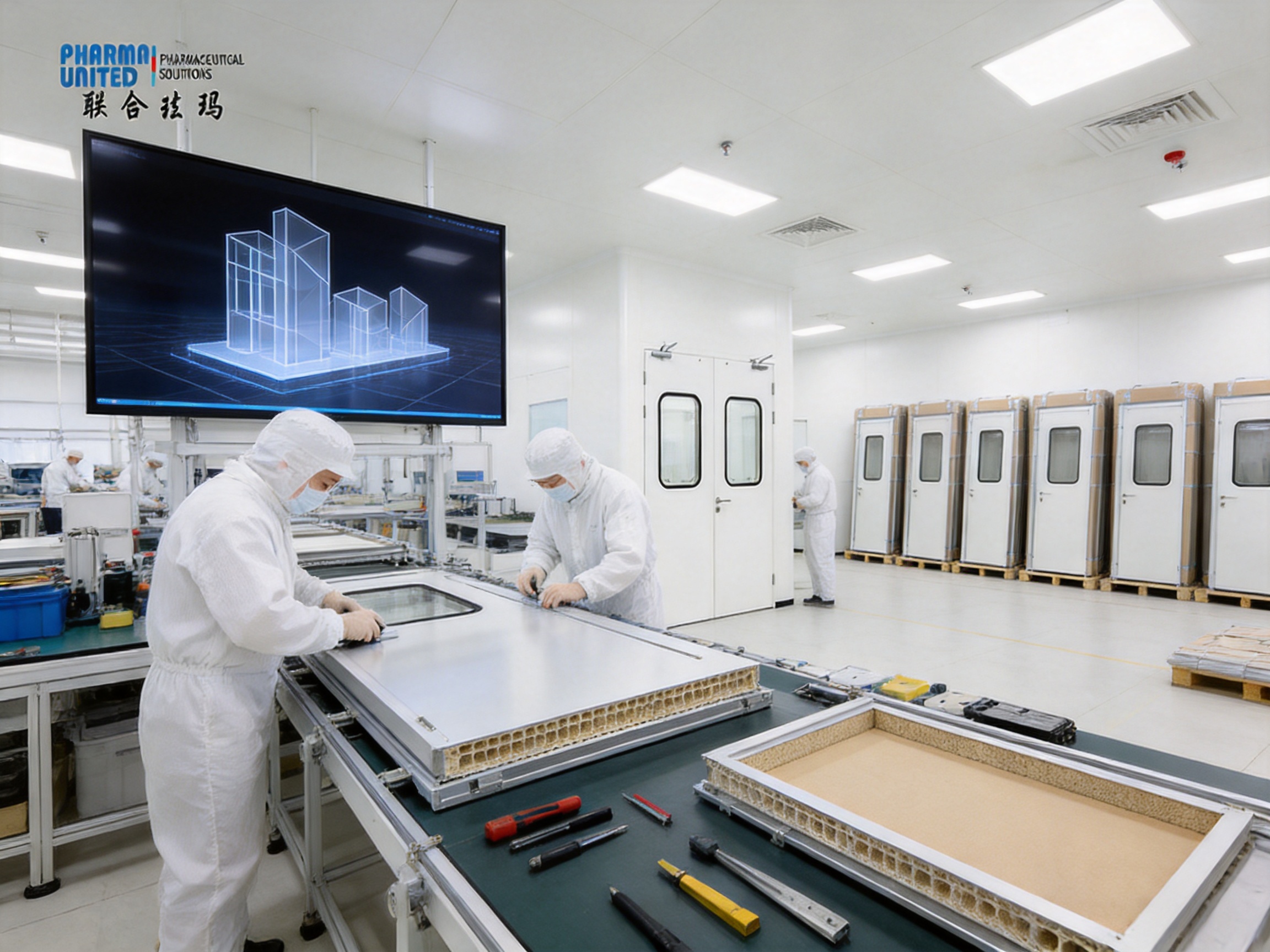
Manufacturing Strengths of the Supplier
Pharma United Co., Ltd. provides cleanroom products and turnkey engineering services for pharmaceutical, healthcare, and industrial applications. Its product range includes metallic sandwich panels, HPL panels, cleanroom doors and windows, HVAC systems, and cleanroom equipment.
The company operates its own manufacturing facility, which supports control over material preparation, production coordination, quality management, and delivery planning. In a cleanroom project, this integrated capability can be valuable because doors must be coordinated with wall panels, ceiling systems, HVAC layouts, and installation details.
The company reports more than 20 years of industry experience, a factory area of approximately 20,000 square meters, and a workforce of more than 60 staff members. It also reports an annual production output of more than 1,000 40HQ containers. These figures indicate the capacity to support both individual orders and larger multi-room or multi-building projects.
The manufacturing history developed from Shanghai Sinoarch Co., Ltd., established in 2006, followed by CESE International Co., Ltd. in 2014, the Kunshan factory and Pharma United Co., Ltd. in 2016, and a branch factory in Qianjiang, Hubei, in 2022. In 2026, the Kunshan factory expanded and doubled its previous production capacity.
For buyers, manufacturing scale can provide several practical advantages. It may improve material availability, support standardized production, reduce dependence on outside subcontractors, and help manage orders involving many doors or multiple cleanroom products. It can also contribute to more coordinated delivery schedules for turnkey projects.
Engineering and Turnkey Project Support
A cleanroom door is most effective when it is designed as part of the full facility rather than purchased as an isolated building product. Pharma United provides cleanroom design, material manufacturing, and on-site installation services. This combination allows the door design to be considered alongside room classifications, wall systems, air-handling arrangements, personnel flow, material flow, and maintenance access.
The company’s engineering team has an average of more than 10 years of on-site experience. Practical site experience is valuable because cleanroom projects often involve coordination between architectural drawings, equipment layouts, mechanical services, electrical systems, and actual construction conditions.
BIM visualization can be used to review room layouts, door positions, access routes, ceiling services, and potential clashes before construction. A coordinated digital model may help project teams identify whether a door opens into a corridor, interferes with equipment, conflicts with airlocks, or requires a different configuration.
Full installation support can also improve the final result. A cleanroom door may lose much of its intended value if it is installed with incorrect clearances, poor frame alignment, damaged finishes, or incompatible seals. Experienced installation personnel can address these details and coordinate the door with the surrounding cleanroom panels and finishes.
Project Planning and Specification Guidance
Confirm the Room Function
The first step is to identify the room function and the required level of control. A door for a general changing room may have different requirements from a door for a sterile processing room, a laboratory, a high-traffic material corridor, or a chemical preparation area.
Confirm Dimensions and Wall Thickness
Because the door size is customized, the opening dimensions should be verified carefully. The project team should confirm the rough opening, finished opening, wall thickness, floor level, ceiling interface, and installation tolerances. These details should be coordinated with the cleanroom panel manufacturer and the construction contractor.
Review Traffic and Impact Risk
The expected number of daily cycles and the type of traffic should influence hardware selection. Personnel-only doors may require different accessories from doors used by carts, pallet trucks, mobile equipment, or large material containers.
If the lower door area is likely to receive frequent impact, protective plates or other reinforcement may be considered. The standard PCGI door is suitable for practical general use, but extremely high-impact areas may require a more specialized construction.
Select Hardware and Accessories
Hardware should be easy to clean, compatible with the door construction, and suitable for the environmental conditions. Closers should be selected to avoid excessive force while ensuring that the door closes reliably. Handles and locks should support the facility’s access-control strategy.
Where visibility is important, a glazing window may be added subject to the project design. Where access sequencing is critical, an interlock system may be considered. These features are not part of the standard configuration and should be confirmed before production.
Coordinate Cleaning and Chemical Exposure
The cleaning procedure should be discussed during specification. The coating system, hardware, seals, and frame finish should be compatible with the cleaning agents and disinfectants used in the facility. Operators should also understand which chemicals, temperatures, concentrations, and cleaning tools may damage the surface.
Consider Installation Sequence
Cleanroom doors may be installed at different stages depending on the project sequence. Early installation may expose the door to construction dust, impact, and damage. Late installation may create access or coordination problems. The installation schedule should protect the finished door while allowing the surrounding wall and floor systems to be completed correctly.
Installation Recommendations
Before installation, inspect the door, frame, packaging, hardware, and opening. Confirm that the dimensions correspond with the approved drawings. Any visible transportation damage should be recorded before the door is installed.
The frame should be positioned accurately and checked for plumb, level, squareness, and correct relationship with the wall system. The frame must be securely fixed according to the approved installation method. Gaps around the frame should be treated in a way that is compatible with the cleanroom construction and the required hygienic finish.
The door leaf should be hung so that it opens and closes smoothly without rubbing against the frame or floor. Hardware should be adjusted to achieve reliable operation. The door should not require excessive force, and the closing action should be suitable for the pressure relationship between the rooms.
After installation, inspect the surface for scratches, dents, contamination, and incomplete protection. Check that all hardware is secure and that seals, if included, are continuous and correctly positioned. The completed installation should be cleaned using approved materials before the room enters commissioning or qualification activities.
Where the door is installed in a pressure-controlled room, the cleanroom commissioning team should verify that the door does not interfere with the intended pressure cascade. Air leakage, door swing, closing behavior, and access procedures should be assessed as part of the overall room performance review.
Maintenance and Service Life
Routine maintenance is necessary to preserve the door’s performance. Operators should inspect the door at defined intervals and document any damage, misalignment, corrosion, loose hardware, or deterioration of seals.
Cleaning should normally begin with removal of loose dust and particles using an approved method. The surface can then be wiped with the facility’s authorized cleaning solution. Cleaning personnel should avoid abrasive pads, metal scrapers, sharp objects, and unapproved solvents.
Hinges and closers should be checked for smooth operation. Any lubrication must be suitable for the cleanroom environment and should not create a contamination risk. Handles, locks, and other frequently touched areas may require more frequent cleaning than the main door surface.
If the coating is scratched, the damage should be assessed promptly. Small surface defects may be repairable according to the coating manufacturer’s recommendations. Larger damage should be reviewed to determine whether moisture could reach the galvanized steel or whether the panel requires replacement.
Door alignment should also be monitored. A door that begins to drag, remain partly open, or close too quickly may indicate hinge movement, frame settlement, hardware wear, or a change in floor conditions. Early adjustment can prevent greater damage and reduce disruption to cleanroom operations.
Cost Efficiency and Lifecycle Value
Initial purchase price is important, but the total value of a cleanroom door should also include installation, cleaning, maintenance, replacement frequency, and the effect of downtime. A cost-effective product is not simply the least expensive door. It is a door that provides appropriate performance for the application without unnecessary features.
The PCGI door supports cost efficiency through several design decisions. The pre-coated surface reduces the need for field painting. The steel construction provides a practical level of durability. The paper honeycomb infill helps control weight and material use. Customized production reduces the need for improvised site modifications. The standard configuration avoids adding glazing or interlock systems where they are not needed.
For large facilities, these savings can become significant because the number of doors may be substantial. Pharmaceutical plants, hospitals, laboratories, and electronics factories may require dozens or hundreds of cleanroom doors. A standardized and coordinated product can simplify procurement, installation, spare-parts planning, and maintenance training.
The product also allows selective upgrading. Advanced features can be specified for rooms with special requirements, while standard PCGI doors can be used in general areas. This approach helps maintain design consistency without applying the highest-cost specification to every opening.
Limitations and Appropriate Use
Responsible product selection requires recognizing where a standard PCGI door may not be sufficient. The product is designed for standard cleanroom applications, but some locations may require additional performance characteristics.
Projects requiring certified fire resistance, acoustic separation, blast resistance, lead shielding, hermetic sealing, high-impact performance, extreme-temperature operation, or automatic high-speed movement should be evaluated separately. The standard paper honeycomb infill and basic configuration may not meet such requirements without modification.
Similarly, areas exposed to continuous washdown, aggressive chemicals, high humidity, salt spray, or severe mechanical impact may require a different coating, stainless steel construction, reinforced panel, or specialized threshold detail.
These limitations do not reduce the value of the PCGI door for its intended purpose. They simply underline the importance of matching the product to the operating environment. Pharma United’s engineering team can review project conditions and help determine whether the standard configuration or an upgraded option is appropriate.
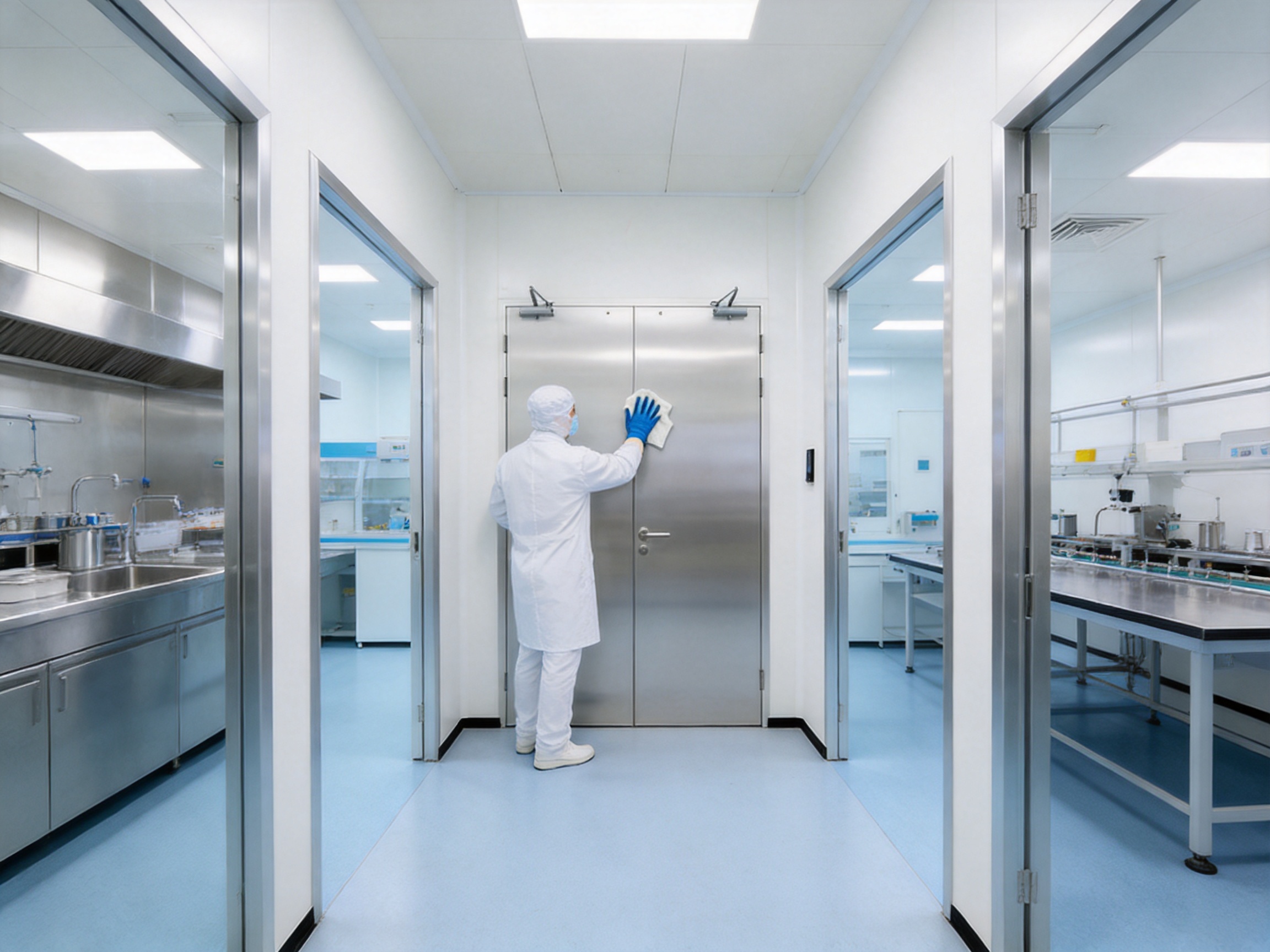
Why Choose an Integrated Cleanroom Supplier?
Purchasing doors from an integrated cleanroom supplier can simplify project coordination. The same supplier may be able to provide wall panels, ceilings, doors, windows, HVAC systems, and installation services. This can reduce the number of separate interfaces that the main contractor and owner must manage.
Integrated supply is particularly useful when the door frame must align with a specific wall panel system. It can also help maintain consistent finishes, dimensions, delivery schedules, and documentation across a project.
Pharma United’s experience includes cleanroom design, manufacturing, and on-site installation. The company has completed projects in Africa, the Middle East, South Asia, and other international markets. Experience across different regions can support awareness of varying site conditions, logistics requirements, contractor structures, and project expectations.
The company’s project experience includes work connected with multinational pharmaceutical companies such as Sanofi and Novartis, as well as industrial plants in international markets. Such experience demonstrates familiarity with projects where documentation, coordination, quality, and schedule management are important.
Frequently Asked Questions
What does PCGI mean in a cleanroom door?
PCGI refers to pre-coated galvanized iron or steel. The steel sheet is galvanized for corrosion protection and coated in a controlled manufacturing process before it is formed into the door panel. The finished surface is smooth, cleanable, and suitable for many standard cleanroom applications.
What is the standard core material?
The standard door uses paper honeycomb as the infill material. This lightweight cellular structure helps support panel rigidity while keeping the door practical to handle and economical to manufacture.
Can the door size be customized?
Yes. The listed size is customized. Final dimensions should be confirmed according to the cleanroom wall system, opening size, traffic requirements, hardware, and project drawings.
Does the standard door include a vision window?
No. The standard information lists the glazing window as not included. A vision window may be considered as an additional project requirement, subject to design review and confirmation before production.
Does the standard door include an interlock?
No. The standard configuration does not include an interlock. Interlocking may be required in personnel or material airlocks and should be specified separately when necessary.
Is the door suitable for pharmaceutical facilities?
Yes. The door is designed for standard GMP cleanroom areas and is suitable for many pharmaceutical production, support, laboratory, storage, and access applications. The final configuration should be checked against the facility’s validation, pressure-control, cleaning, and traffic requirements.
Is the PCGI surface easy to clean?
Yes. The smooth factory-coated surface is designed to support routine wiping and cleaning. The cleaning method must follow the facility’s approved procedures, and abrasive tools or incompatible chemicals should be avoided.
Is the door suitable for hospitals?
It can be used in many hospital controlled areas, laboratories, pharmacies, sterile processing spaces, and other locations where a smooth, cleanable, steel door is appropriate. High-traffic or specialized healthcare areas may require upgraded hardware or a different door type.
Can the door be used in food workshops?
Yes. The coated galvanized steel construction is suitable for many standard food production and processing areas. The project team should review humidity, washdown frequency, cleaning chemicals, and impact exposure before final selection.
What is the main advantage over a conventional steel door?
The main advantage is the combination of a galvanized substrate and a controlled factory-applied coating. This provides a more suitable, consistent, and cleanable surface than many ordinary painted or untreated steel doors.
Is the door suitable for high-impact areas?
The standard product is intended for normal cleanroom use. If the door will be exposed to frequent impact from carts, pallet trucks, or machinery, reinforcement, protective accessories, or a specialized high-impact construction should be considered.
Can the manufacturer provide installation support?
Yes. Pharma United provides cleanroom design, manufacturing, and on-site installation services. Installation support can help coordinate the door with the surrounding wall panels, ceiling, floor, HVAC systems, and project commissioning process.
What information should be provided when requesting a quotation?
Useful information includes the number of doors, opening dimensions, wall thickness, room locations, door handing, operating direction, traffic type, required hardware, desired finish, cleaning chemicals, glazing requirements, interlock requirements, and project delivery location.
How should the door be maintained?
The door should be cleaned according to the facility’s approved procedures and inspected regularly for scratches, corrosion, loose hardware, misalignment, damaged seals, or abnormal operation. Problems should be corrected early to protect the cleanroom envelope and extend service life.
Conclusion
The Cleanroom PCGI Door is a practical solution for controlled environments that require a smooth, hygienic, corrosion-resistant, and economical door assembly. Its pre-coated galvanized steel surfaces provide a suitable finish for routine cleaning, while the steel frame and steel panel offer stable construction. The paper honeycomb infill contributes to a lightweight and cost-effective design.
Its customized dimensions make it adaptable to pharmaceutical factories, laboratories, hospitals, food workshops, electronics cleanrooms, and other standard GMP or controlled areas. The simple configuration also allows project teams to reserve more advanced door systems for locations that truly require automatic operation, interlocking, glazing, high-impact resistance, or specialized sealing.
The product is supported by Pharma United’s manufacturing capacity, engineering experience, product range, BIM capability, international project background, and on-site installation services. With its own factory, more than two decades of industry experience, a reported 20,000-square-meter production area, more than 60 staff members, and expanded production capacity, the company is positioned to support both individual cleanroom door orders and integrated turnkey projects.
For the best result, the door should be specified as part of the complete cleanroom system. Careful coordination of dimensions, wall construction, hardware, traffic, cleaning procedures, pressure relationships, and installation sequence will help ensure reliable operation. When matched to the right application, the PCGI cleanroom door offers a balanced combination of hygiene, durability, maintainability, and project value.
References
1. Product technical information for the Cleanroom PCGI Door, including construction, standard configuration, and application details.
2. Pharma United Co., Ltd. company information concerning cleanroom design, manufacturing, installation, factory capacity, engineering services, and international project experience.
3. Good Manufacturing Practice principles concerning cleanable surfaces, contamination control, facility design, and controlled access.
4. General cleanroom engineering practice for room pressure control, personnel and material flow, cleanroom envelope coordination, and maintenance planning.
5. General architectural and manufacturing guidance for galvanized steel, pre-coated metal surfaces, cleanroom doors, and hygienic facility finishes.
Product: Cleanroom PCGI Door



-
Mobile
+86-177 1554 8238
-
E-mail
chin@pharma-united.com
-
Address
No.58 Beiyuan Road, Dianshanhu Town, Kunshan City, Jiangsu Province, China
Copyright © Pharma United Co., Ltd. Rights Reserved.
OEM/ODM Cleanroom Engineering Solution Manufacturers
